Industry insights
Invoice number series rules under GST for small firms
Under GST an invoice number has up to 16 characters, runs in one or more series and is never repeated in a financial year. Start a fresh series each April.
Written by The iCRM team
Published 6 min read
- 16 characters The most an invoice number can have
- 2 symbols Allowed, the hyphen and the slash
- 1 April When a fresh series usually starts
- ₹5 crore Turnover that brings in e-invoicing
On this page
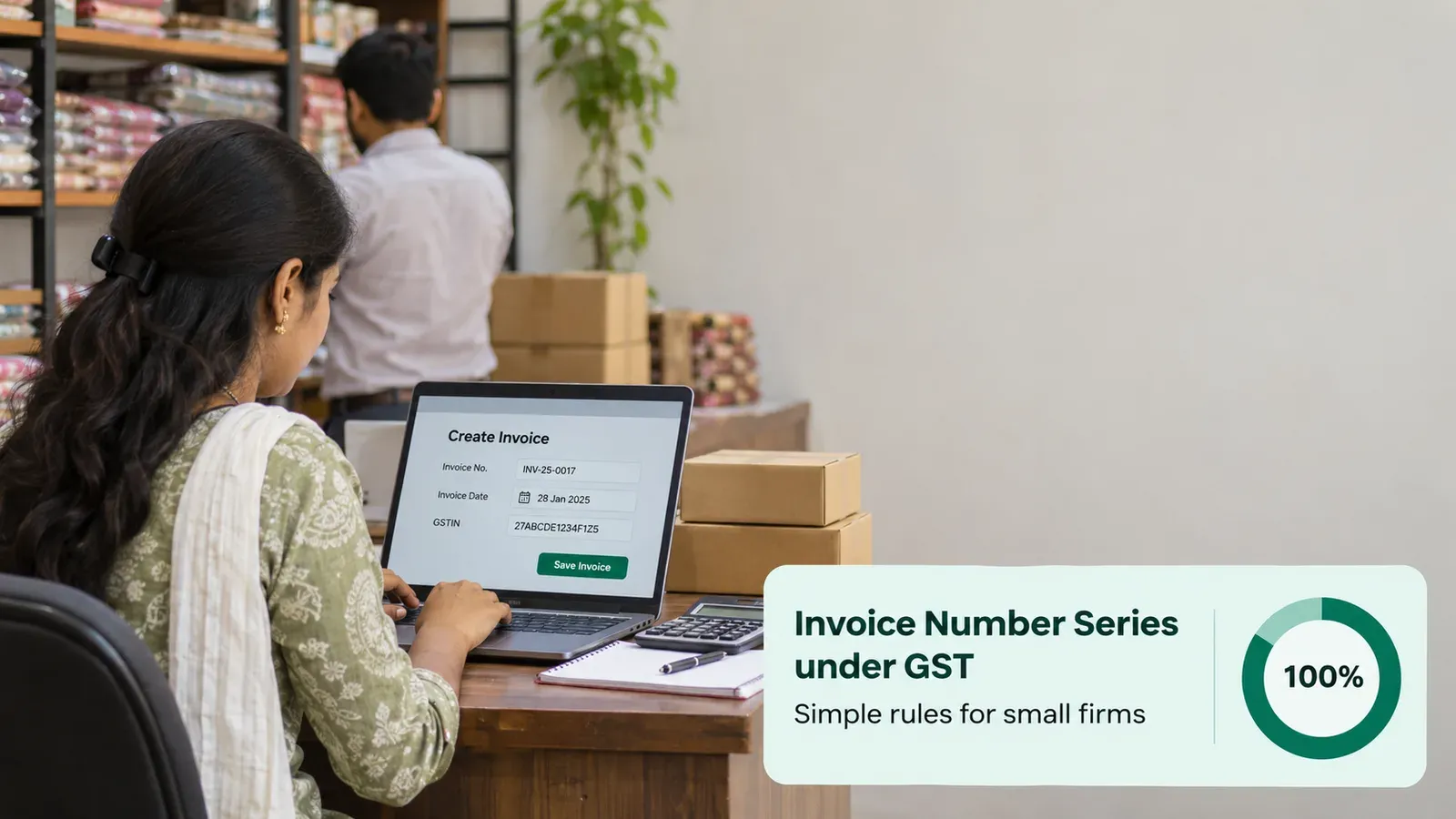
Under GST, every tax invoice carries a serial number of no more than 16 characters, made of letters, numbers, hyphens and slashes. The numbers run in one or more series and must be consecutive and unique within the financial year. Set the pattern once, start fresh each April, and your auditor and GST officer will have little to question.
Key takeaways
- An invoice number has 16 characters at most, prefix and year code included.
- Use only letters, numbers, the hyphen (-) and the slash (/).
- No number may repeat in the same financial year, for the same GSTIN.
- Start a new series on 1 April, as the GSTN advised in 2019.
- Keep a separate series for each branch or document type when it helps.
What does the GST rule actually say?
The rule is Rule 46 of the CGST Rules, 2017, which lists what a tax invoice must show. Its clause (b) asks for “a consecutive serial number not exceeding sixteen characters”. The number may run in one series or in several. It may use letters, numbers, the hyphen and the slash, in any combination. And it must be unique for a financial year.
The same pattern appears in the rules for other documents. Bills of supply (Rule 49), receipt, refund and payment vouchers (Rules 50 to 52), and credit and debit notes (Rule 53) all ask for a consecutive serial number within the same limits.
Three words matter most:
- Consecutive. Numbers follow one another with no gaps you cannot explain.
- Unique. The same number is never used twice in the year.
- Sixteen. Every character counts, the slashes included.
How to build a number that fits in 16 characters
Most small firms use three parts: a short prefix, the financial year, and a running number. The trap is that a long prefix and a full year code push the number past 16 characters.
| Invoice number | Characters | Fits the rule? |
|---|---|---|
| INV/2026-27/00001 | 17 | No, one too many |
| INV/26-27/00001 | 15 | Yes |
| MUM/26-27/00001 | 15 | Yes |
| CN/26-27/0001 | 13 | Yes |
| INV 26.27 #1 | 12 | No, spaces, dots and # are not allowed |
A few habits keep the numbers clean:
- Count the characters before you print the first invoice of the year.
- Leave room for growth. Five digits allow up to 99,999 invoices in a series.
- Use the same case every time. Some systems treat “inv” and “INV” as the same number, so a change of case does not make a number new.
- Never add a space, a dot, a hash or an underscore.
When should you start a new series?
The rule itself asks only that numbers be unique within a financial year. In April 2019 the GSTN issued an advisory telling taxpayers to start a new series from 1 April, the first day of the financial year, and most accountants now treat that as the normal practice. Putting the year in the prefix, such as 26-27, makes each year’s numbers unique on sight.
Start a new series in these cases:
- A new financial year begins on 1 April.
- You take a new GSTIN, for example a registration in another state. Each registration keeps its own numbering.
- You open a branch that will bill on its own, under the same GSTIN.
- You start a new document type, such as credit notes or receipt vouchers.
Do not start a new series in the middle of the year just to tidy up. Changing the pattern part way through makes the year harder to reconcile, and harder to explain at an audit.
Separate series for branches and document types
The rule allows several series at once. Used well, they make the books easier to check.
| Use | Example series | Why it helps |
|---|---|---|
| Tax invoices, head office | MUM/26-27/00001 | One clear run for the main office |
| Tax invoices, Pune branch | PUN/26-27/00001 | No clash with head office numbers |
| Credit notes | CN/26-27/0001 | Returns and discounts kept apart |
| Debit notes | DN/26-27/0001 | Extra charges easy to find |
| Receipt vouchers | RV/26-27/0001 | Advances tracked on their own |
| Bills of supply | BOS/26-27/0001 | Exempt sales kept apart |
Two branches under one GSTIN that both start at 00001 with no prefix would issue the same number twice in a year, which breaks the rule. A short branch prefix solves it.
Keep the list of series short and written down. Your accountant should be able to see at a glance which series exist and who issues from each.
What about cancelled invoices, GSTR-1 and e-invoices?
A mistake on an invoice is never fixed by reusing its number. Cancel it, keep the record, and issue a new invoice with the next number in the series.
Your monthly or quarterly GSTR-1 return has a table for documents issued (Table 13). For each series you give the first and last number, the total issued and how many were cancelled. A clean, separate series for each document type makes this table quick to fill in and easy to match.
If your aggregate turnover has gone past ₹5 crore in any financial year since 2017-18, you must also report B2B invoices to the Invoice Registration Portal as e-invoices. The portal rejects a second document with the same number, type and financial year from the same GSTIN. Clean numbering avoids those rejections.
Doing it in iCRM
These features are common to every industry in India.
- Invoicing. Create invoices in the same place you keep your customers, so each invoice sits with the customer it belongs to.
- Tax management. Set your GST rates once and apply the right rate to each item, so the tax shows on every invoice.
- Payment tracking. Record payments against invoices and see which are paid, part-paid or still due.
- Document sharing. Share invoices and credit notes with your accountant and your customers, working from the same version.
- Task management. Give the year-end jobs an owner and a due date: count the characters in the new pattern, start the new series on 1 April, and send the documents issued figures for GSTR-1.
Check your invoice numbering pattern with your accountant before you set it up, so it suits your registrations and branches.
An invoice number series checklist
- Every number is 16 characters or fewer, prefix and year included.
- Only letters, numbers, hyphens and slashes are used.
- No number repeats within the financial year for the same GSTIN.
- A new series starts on 1 April each year.
- Each branch billing under one GSTIN has its own prefix.
- Credit notes, debit notes and vouchers each have their own series.
- Cancelled numbers stay in the series and are marked cancelled.
- The series list is written down and shared with your accountant.
- The documents issued table in GSTR-1 matches each series.
Sources
- Rule 46, Tax invoice, CGST Rules 2017, CBIC tax information portal
- Tax invoice, CGST Rule 46, GSTZen
- GSTN issues advisory to start new invoice series, Masters India
- Form GSTR-1, creation and submission of statement of outward supplies, GST portal user manual
- Invoice numbering mistakes under GST, Busy
- Duplicate IRN prevention checklist for multi-branch businesses, GimBooks
Related articles
-
Law firm case management in India: hearings, files and fees
Give every matter one file with its CNR, next hearing, papers, client updates and fee invoices, so a small practice stops running on diaries and memory.
- Checklist
- 2 tables
- 6 questions answered
-
Managing hotel group and corporate booking enquiries
Handle hotel group booking enquiries in one place, from first call to quote, advance and final bill, with the right GST rate on rooms, food and banquets.
- Checklist
- 1 table
- 5 questions answered
-
Patient follow-up reminders for clinics: quick tips
Book the next visit before the patient leaves, remind them twice, say a report is ready without the result, and keep health details private under the DPDP Act.
- Checklist
- 1 table
- 5 questions answered
Recognized with numerous awards
Support, security, uptime and results, with the figures behind each badge.















FAQ
Frequently asked questions
Straight answers to what people ask most about iCRM.
Set up for your industry
Pick yours and its features come ready.
- Farm Businesses
- Automotive Dealers
- Consulting Firms
- Online Retail
- Education Institutes
- Energy Companies
- Financial Services
- Healthcare Clinics
- Hospitality Businesses
- Law Firms
- Logistics Companies
- Manufacturing Companies
- Media Agencies
- Nonprofit Organisations
- Real Estate
- Technology Companies
-
How long can a GST invoice number be?
Up to 16 characters in all, counting every letter, number, hyphen and slash. Prefixes and year codes count towards the 16, so keep them short.
-
Which characters can I use in a GST invoice number?
Letters, numbers, the hyphen and the slash, in any mix. Leave out spaces, dots, underscores and other symbols, which the rule does not list.
-
Do I have to restart invoice numbers from 1 every April?
The rule asks for numbers that are consecutive and unique within a financial year. A GSTN advisory of April 2019 told taxpayers to start a new series each year, and most firms do so, often with the year in the prefix.
-
Can my branches use their own invoice series?
Yes. The rule allows one or more series. Give each branch its own short prefix so two branches under the same GSTIN never issue the same number in a year.
-
Can I reuse the number of a cancelled invoice?
No. Keep the cancelled number in the series, mark it cancelled and keep the record. It is counted as cancelled in the documents issued table of GSTR-1.
-
Do credit notes need a separate number series?
Credit and debit notes, receipt vouchers and bills of supply each carry a consecutive serial number under the same 16-character limit. A separate series for each document type keeps them apart and easy to report.
Get started with iCRM
Leads, quotes, work, invoices and payments in one app, set up for the way your industry works.
- 99% Uptime guarantee
- ISO ISO-aligned security
- 24/7 Response support
- GDPR GDPR compliant
- SSL SSL encrypted
-
16
Industries Each with its own features
-
47
Features Across those industries
-
11
Areas of work From leads to payments
-
3
Editions India, France and UAE