Industry insights
Patient follow-up reminders for clinics: quick tips
Book the next visit before the patient leaves, remind them twice, say a report is ready without the result, and keep health details private under the DPDP Act.
Written by The iCRM team
Published 7 min read
- 2 reminders Before every review visit
- 1 owner For each patient's next step
- 72 hours To give records a patient asks for
- 3 years To keep indoor patient records
On this page
- Key takeaways
- Tip 1: book the next step at the desk, not later
- Tip 2: match the reminder to the visit
- Tip 3: keep health details out of the message
- Tip 4: ask first, and write down the answer
- Tip 5: give the list one owner
- Tip 6: keep records in order, and to the right people
- Doing it in iCRM
- A patient follow-up reminder checklist
- Sources
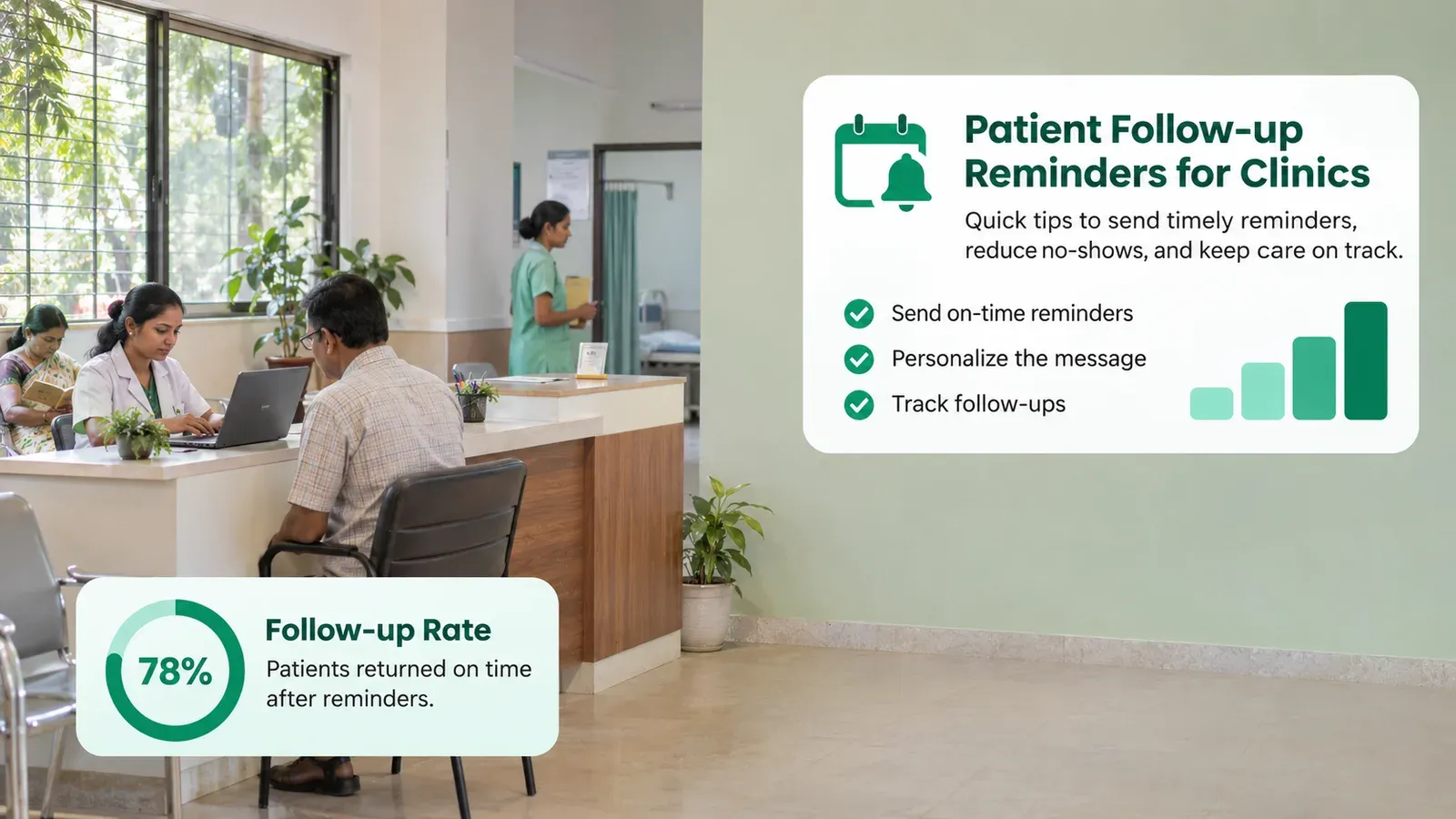
Most clinics do not lose patients because of the care they give. They lose them after the first visit, when the review date is written on a prescription slip and nobody calls. The fix is simple: book the next visit before the patient leaves, remind them twice, and keep the reminder itself free of health details.
Key takeaways
- Book the review, the report pick-up or the repeat visit before the patient walks out.
- Send two reminders: two days before and on the morning.
- Say a report is ready. Never put the result in the message.
- Ask at registration whether the patient wants reminders, and on which number.
- Give one person the list of who is due each day.
Tip 1: book the next step at the desk, not later
The best moment to fix a review date is while the patient is still in front of you. They have the doctor’s advice fresh in mind, and they can check their own dates on the spot.
Make it part of checkout. The doctor writes when the patient should return. The front desk books a slot, says it out loud, and writes it on the slip. If the patient cannot decide, book a call-back date instead, so there is still a next step on their record.
A patient with no next date on their record is a patient you have already started to lose.
Tip 2: match the reminder to the visit
Not every follow-up is the same. A diabetes review, a blood report and a dressing change need different timing. Set the gaps once, so the desk does not have to decide each time.
| Follow-up | First reminder | Second reminder | If missed |
|---|---|---|---|
| Review visit | 2 days before | Morning of the visit | Call the same day |
| Report ready | When the lab sends it | 3 days later, if not collected | Call and ask how they want it |
| Repeat visit (dressing, injection, therapy session) | The day before | 2 hours before | Call within the hour |
| Long-term check (every 3 or 6 months) | 1 week before | 2 days before | Call within 2 days |
Keep each message short. Give the clinic’s name, the date and time, the doctor’s name and a number to call to change it. Nothing more is needed.
Tip 3: keep health details out of the message
A reminder goes to a phone, and phones are shared. A spouse, a child or a colleague may read it on the lock screen. So the message should say what to do, never what is wrong.
A reminder that keeps details private
Dear Mrs Sharma, your review with Dr Rao at Sunrise Clinic is on Thursday at 11 am. To change it, please call 98xxx xxxxx.
A report message that keeps details private
Dear Mr Iyer, your report is ready at Sunrise Clinic. Please collect it from the desk or call us to discuss it with the doctor.
Avoid words such as the test name, the condition or the medicine. If the patient wants the report sent to them, agree how at the desk, and note it on their record.
If you send reminders by bulk SMS, your sender must be registered on the telecom operators’ DLT platform, with each message template approved under the TRAI rules for commercial messages. Your SMS provider can take you through this.
Tip 4: ask first, and write down the answer
The Digital Personal Data Protection Act 2023 sets out how a business in India may use people’s personal data. Its rules were notified in November 2025, and most duties, such as notices, consent and security, apply about 18 months after that. Health details are among the most sensitive data a clinic holds, so it is worth getting ready now.
In plain terms, a clinic should:
- Tell patients, in simple words, what details it collects and why. A short notice at registration works.
- Ask whether they want reminders, on which number, and in which language.
- Use the details only for the purpose it gave.
- Let a patient stop reminders when they ask, and note it.
- Keep the records safe, and limit who can see them.
The law also expects a business to act quickly if data is leaked, by telling the people affected and the Data Protection Board. This is general guidance, not legal advice. For your own clinic, speak to a lawyer who knows the DPDP Act.
Tip 5: give the list one owner
When everyone at the desk can call a patient, nobody does. Each morning, one named person takes the list of who is due: reviews, reports and repeat visits. A colleague covers when they are away.
At the end of the day, every name on the list should have one of three notes: confirmed, rebooked or declined. A patient who declined should not be called again for that visit.
Keep a short reason for each missed visit. Over a few weeks, you will see patterns, such as Monday mornings or one doctor’s slots, that you can fix.
Tip 6: keep records in order, and to the right people
Reminders only work when the record behind them is right. A wrong number or an old address wastes the desk’s time and can send a message to the wrong person.
Under the National Medical Commission’s Code of Medical Ethics Regulations 2002, a doctor must keep indoor patients’ records for three years from the start of treatment, and give a patient’s records within 72 hours when the patient or the authorities ask. Records kept on a computer are easier to find in time.
Not everyone in the clinic needs to see everything. The front desk needs the name, number and the next date. The doctor needs the notes. Keep it that way.
Doing it in iCRM
These features are part of iCRM for healthcare in India:
- Customer management. Every patient in one place, with their details, history and the next visit, so the desk can search for anyone in seconds.
- Contact management. Keep the right person to reach for each patient, such as a son who books for an elderly parent, and note who should get the reminder.
- Calendar. See reviews, repeat visits and calls for each doctor on one calendar, so the desk books the next slot before the patient leaves.
- Automated reminders. Set the gaps once, and iCRM reminds your team who is due and when, so no review waits on memory.
- Task management. Give the day’s follow-up list to one person, with a due date, and see what is done.
- Private notes. Keep the reason for a missed visit, or the patient’s wish to stop reminders, on their record for the team only.
- Customer portal. Share documents with a patient in their own place to sign in to, instead of sending them over chat.
- Role-based permissions and record-level permissions. Decide what the desk, the nurses and the doctors can see, and limit a record to the people caring for that patient.
- Account security. Control who can sign in, and remove access the day someone leaves.
- Invoicing and payment receipts. Keep each bill and receipt with the patient it belongs to.
A patient follow-up reminder checklist
- Every patient leaves with the next date booked, or a call-back date.
- Each kind of follow-up has its reminder gaps set once.
- Reminders give the date, time, doctor and a number. No health details.
- Reports are announced as ready, never sent as results in a message.
- Consent for reminders, the number and the language are noted at registration.
- Patients who ask to stop reminders are marked and not called again.
- One person owns each day’s list, with a colleague to cover.
- Missed visits get a call and a short reason on the record.
- Access to records is limited to the people who need it.
- Bulk SMS templates are registered on DLT through your provider.
Sources
- Ministry of Electronics and Information Technology: The Digital Personal Data Protection Act, 2023
- India Briefing: Digital Personal Data Protection Rules 2025 notified
- KPMG India: The privacy prescription, impact of the DPDP Act and Rules in healthcare
- National Medical Commission: Code of Medical Ethics Regulations, 2002
- Telecom Regulatory Authority of India: Telecom Commercial Communications Customer Preference Regulations
Related articles
-

Quick tips to follow up WhatsApp leads before they go cold
Log every WhatsApp enquiry as a lead the same day, reply within the hour, set a next follow-up date and sort chats with labels so none is lost.
- Checklist
- 3 tables
- 5 questions answered
-

Quotation format for Indian businesses: what to include
A clear quotation format in India shows both GSTINs, item rates with HSN or SAC, GST apart from the price, a validity date and plain payment terms.
- Checklist
- 2 tables
- 6 questions answered
-

Part 1: Real estate lead management in India: a builder's guide
Bring every enquiry from portals, ads, hoardings and walk-ins into one list, reply within minutes and give each lead one sales person with a next date.
- Checklist
- 3 tables
- 6 questions answered
Recognized with numerous awards
Support, security, uptime and results, with the figures behind each badge.














FAQ
Frequently asked questions
Straight answers to what people ask most about iCRM.
Set up for your industry
Pick yours and its features come ready.
- Farm Businesses
- Automotive Dealers
- Consulting Firms
- Online Retail
- Education Institutes
- Energy Companies
- Financial Services
- Healthcare Clinics
- Hospitality Businesses
- Law Firms
- Logistics Companies
- Manufacturing Companies
- Media Agencies
- Nonprofit Organisations
- Real Estate
- Technology Companies
-
How many reminders should a clinic send before a review visit?
Two is enough for most patients. Send one two days before, so they can plan leave or travel, and one on the morning of the visit. More than that starts to feel like pressure, and the patient may stop reading them.
-
Can we send test results to a patient on WhatsApp or SMS?
It is safer to say only that the report is ready, and to share the result itself through a channel the patient has agreed to, or in person. A phone can be seen or shared by family, so keep the diagnosis and values out of reminder messages.
-
Do we need the patient's consent to send follow-up reminders?
Under the DPDP Act 2023, a clinic should tell patients in plain words what it collects and why, and get their consent before using their details. Ask at registration whether they want reminders, on which number and in which language, and note the answer on their record.
-
What should we do when a patient misses a review?
Call the same day or the next. Ask whether they still want to come, offer two slots, and note the reason. If they decline, record it and stop. A short, kind call often brings back a patient who simply forgot.
-
Who in the clinic should send the reminders?
One named person at the front desk for each day's list, with a colleague covering when they are away. The doctor decides when the patient should return. The front desk makes sure it happens.
Get started with iCRM
Leads, quotes, work, invoices and payments in one app, set up for the way your industry works.
- 99% Uptime guarantee
- ISO ISO-aligned security
- 24/7 Response support
- GDPR GDPR compliant
- SSL SSL encrypted
-
16
Industries Each with its own features
-
47
Features Across those industries
-
11
Areas of work From leads to payments
-
3
Editions India, France and UAE