Industry insights
GST credit note rules: when and how to issue one
Under Section 34 you issue a GST credit note when goods come back, a price is cut or a bill was too high, and declare it by 30 November after the year ends.
Written by The iCRM team
Published 7 min read
- 3 reasons Returns, price cuts, billing errors
- 30 November Last date after the year ends
- 16 characters Longest serial number allowed
- 1 invoice Named on every credit note
On this page
A GST credit note is the document you issue when an invoice you have already sent charged too much. Section 34 of the CGST Act covers it: goods come back, the price is cut, or the bill had the wrong value or tax. You never edit the first invoice. You issue a credit note that names it, and declare it in your return by 30 November after the financial year ends.
Key takeaways
- Issue a credit note when the invoice shows more value or tax than is really due.
- Every credit note must name the first invoice by its serial number and date.
- Declare it no later than 30 November after the year of the supply, or the annual return date if earlier.
- Your tax goes down only once the buyer has reversed the matching input tax credit, where they claimed it.
- Rules on discounts after the sale changed on 1 November 2026, so check them with your accountant.
When is a GST credit note needed?
Section 34(1) allows a registered supplier to issue a credit note in a few cases. They all have one thing in common: the first tax invoice charged more than the customer really owes.
| What happened | Example | Credit note? |
|---|---|---|
| Goods returned | A dealer sends back 20 damaged cartons | Yes |
| Price cut after the sale | You agree a lower rate after a complaint | Yes, if the GST rules on discounts are met |
| Value or tax too high | The bill showed 18% where 12% applied | Yes |
| Service short of the bill | Three of four agreed site visits took place | Yes |
| Value or tax too low | A rate was missed off the bill | No, issue a debit note |
If you simply typed a wrong address or a spelling mistake, the value and tax are right. That is usually not a case for a credit note. Talk to your accountant about the right way to fix it.
Discounts after the sale
Discounts given after the invoice have their own rules under Section 15(3). From 1 November 2026, the Finance Act 2026 changed these rules. A discount given after the sale now counts as a ground for a credit note in Section 34(1). Commentators report that the old conditions of a prior agreement and a link to set invoices are gone. The buyer must still reverse the input tax credit linked to the discount.
Discounts dealt with before 1 November 2026 may still fall under the old rules. This is a fresh change, so confirm with your accountant before you rely on it.
What must a GST credit note show?
Rule 53(1A) of the CGST Rules lists what a credit note must carry. Most billing software has these fields. If you write notes by hand or in a spreadsheet, check each one.
- Your name, address and GSTIN.
- The words that show it is a credit note.
- A serial number of up to 16 characters, running in order and unique for the financial year.
- The date you issue it.
- The buyer’s name, address and GSTIN, if they are registered.
- The buyer’s name and delivery address, with the state, if they are not registered.
- The serial number and date of the first tax invoice or bill of supply.
- The value of the goods or services, the tax rate and the amount of tax credited.
- Your signature or digital signature, or that of your authorised person.
Keep a separate series for credit notes, apart from your invoice series. It makes them easy to find and easy to count at the year end.
How does the credit note link to the first invoice?
The link is the heart of the rules. A credit note is not a stand-alone document. It corrects a set invoice, and it must name that invoice’s serial number and date.
The law allows one or more credit notes for one or more invoices. In practice, many small firms keep it simple: one credit note for one invoice. When one note covers several invoices, list each invoice clearly, so your buyer and your accountant can match them.
Before you issue a credit note, check three things.
- The first invoice number and date are right.
- The value and tax you are reducing are not more than the invoice showed.
- The buyer agrees with the change, so they can reverse their credit if they claimed it.
If you use e-invoicing
If your business must issue e-invoices, credit notes are reported to the invoice registration portal too, in the same way as your invoices. Make sure the credit note goes through the same process, so it matches what you file.
What is the time limit to declare a credit note?
Section 34(2) sets the last date to declare a credit note in your return. Since the Finance Act 2022, it is the earlier of two dates:
- 30 November after the end of the financial year in which the supply was made, or
- the date you file the annual return for that year.
| Supply made in | Declare by |
|---|---|
| April 2025 to March 2026 | 30 November 2026, or the annual return date if earlier |
| April 2026 to March 2027 | 30 November 2027, or the annual return date if earlier |
The CBIC said in a 2022 press release that the date is met when the return is filed on the GST portal by 30 November. Leaving it to the November return due later in December will not do.
After the last date, you can still give the customer a credit as a business matter. But your GST will not be reduced by it.
Does the buyer’s input tax credit matter?
Yes. Since 1 October 2025, the Finance Act 2025 change to Section 34(2) says your output tax goes down only once the buyer has reversed the matching input tax credit, where they had claimed it. Before that, the law already said you could not reduce your tax if the tax had been passed on to someone else.
In plain words: a credit note to a registered business works best when both sides know about it. Tell your buyer when you issue it, and ask them to act on it in their own returns.
Doing it in iCRM
iCRM does not replace your accountant or your GST filing. It keeps the paperwork round each correction in order, so nothing is lost between the sale and the return.
- Invoicing. Create invoices in the same place you keep your customers, so the first invoice number and date are easy to find when a correction is needed.
- Payment tracking. See which invoices are paid, part-paid or still due, so you know what the customer still owes once a credit is agreed.
- Document sharing. Keep the credit note, the first invoice and the customer’s letter or return slip together, and share them with your accountant from one place.
- Task management. Give the credit note to one person, with a due date well before 30 November.
- Calendar. Put the return dates and the 30 November limit on one calendar, so nobody misses them.
- Team messaging. Ask the person who made the sale what was agreed, without losing the answer in a phone chat.
A GST credit note checklist
- The first invoice charged more than is really due.
- The reason is clear: a return, a price cut or a billing error.
- The credit note has its own series, up to 16 characters, unique for the year.
- It names the first invoice’s serial number and date.
- It shows the value, the tax rate and the tax credited.
- It carries your GSTIN and the buyer’s, if registered.
- It is signed by you or your authorised person.
- It is reported to the invoice portal, if you issue e-invoices.
- The buyer knows, and reverses their input tax credit where they claimed it.
- It is declared in a return by 30 November after the year ends.
Sources
- Section 34 of the CGST Act, 2017: credit and debit notes (CBIC)
- Rule 53 of the CGST Rules, 2017: revised tax invoice and credit or debit notes (CBIC)
- 9 GST amendments effective from 1 October 2022, Finance Act 2022 (VJM Global)
- CBIC notifies the Finance Act 2025 GST amendments from 1 October 2025 (A2Z Taxcorp)
- GST post-supply discount and refund amendments effective 1 November 2026 (TaxGuru)
- CGST Act amendments by Sections 153 to 155 of the Finance Act 2026 (Lakshmikumaran and Sridharan)
Related articles
-
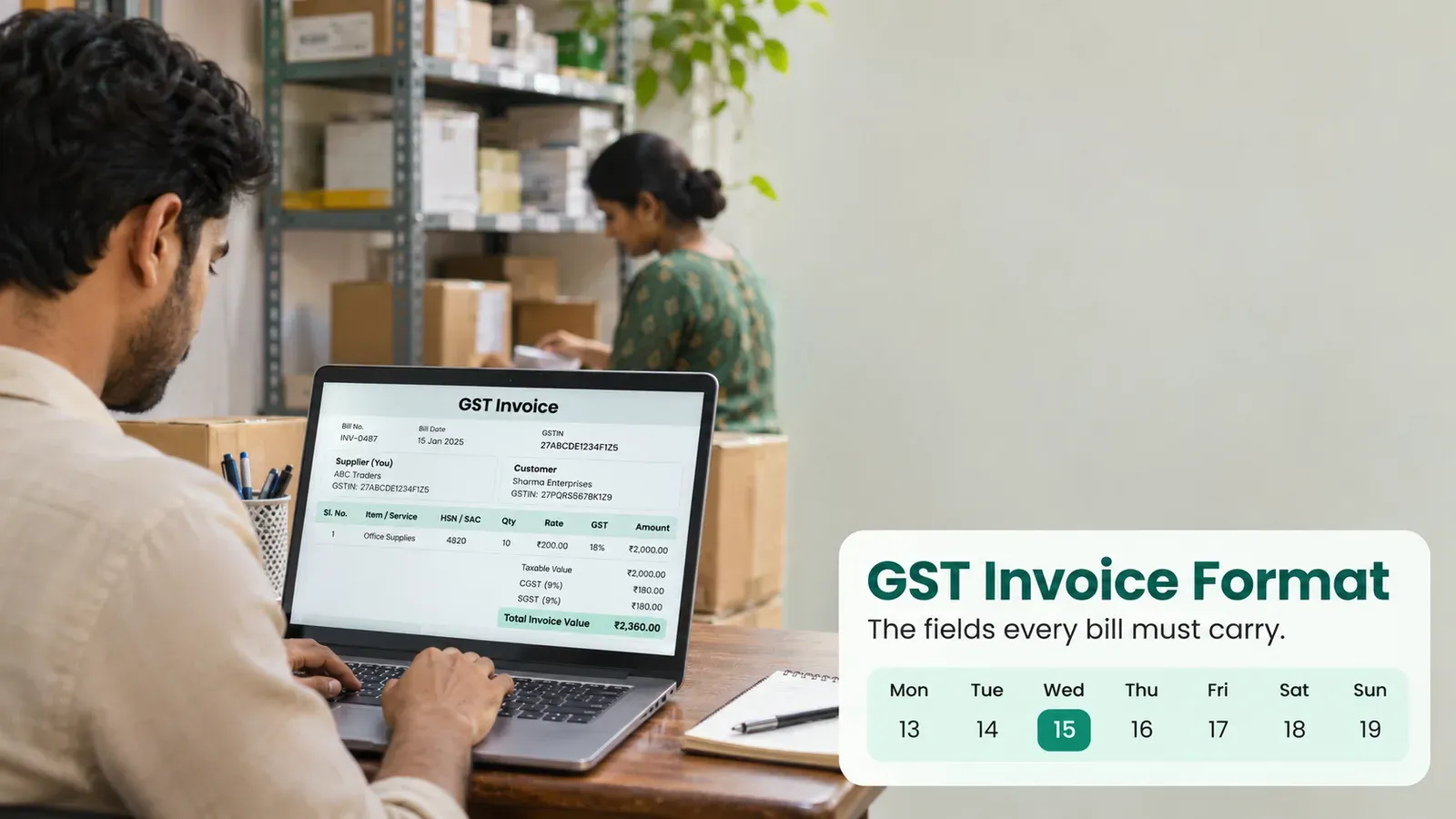
Part 1: GST invoice format: the fields every bill must carry
A GST tax invoice must carry the fields listed in Rule 46 of the CGST Rules, from GSTIN and serial number to HSN or SAC, tax rate and place of supply.
- Checklist
- 2 tables
- 6 questions answered
-

How manufacturers can manage dealer and distributor enquiries
Put every dealer and distributor enquiry from fairs, IndiaMART and calls in one list, qualify it with five questions and follow it to a first order.
- Checklist
- 2 tables
- 6 questions answered
-
Part 2: How to collect overdue payments from clients in India
Remind before the due date, follow a polite schedule after it, send a final notice by day 45, then file on the MSME ODR portal if you are a micro or small unit.
- Checklist
- 2 tables
- 6 questions answered
Recognized with numerous awards
Support, security, uptime and results, with the figures behind each badge.
















FAQ
Frequently asked questions
Straight answers to what people ask most about iCRM.
Set up for your industry
Pick yours and its features come ready.
- Farm Businesses
- Automotive Dealers
- Consulting Firms
- Online Retail
- Education Institutes
- Energy Companies
- Financial Services
- Healthcare Clinics
- Hospitality Businesses
- Law Firms
- Logistics Companies
- Manufacturing Companies
- Media Agencies
- Nonprofit Organisations
- Real Estate
- Technology Companies
-
When do I need to issue a GST credit note?
When the tax invoice shows more than is really payable. The usual cases are goods sent back, a price cut or discount after the sale, a bill with the wrong value or tax, and services found short of what was billed.
-
What is the time limit to declare a GST credit note?
Declare it in a return filed no later than 30 November after the end of the financial year of the supply, or the date you file the annual return for that year, if that is earlier. After that, your tax cannot be reduced by it.
-
Can one credit note cover several invoices?
Section 34 allows one or more credit notes for one or more tax invoices. Each note must still name the serial number and date of the invoice it corrects, so list every invoice it covers. Ask your accountant how to report it.
-
Do I need the buyer's action for the credit note to reduce my tax?
Yes, where the buyer has claimed input tax credit on the first invoice. Since the 2025 change to Section 34(2), your output tax is reduced only once the buyer has reversed the matching input tax credit.
-
What is the difference between a credit note and a debit note?
A credit note lowers what the first invoice charged, for example after a return. A debit note raises it, for example when the price was billed too low. Both must link to the first invoice.
Get started with iCRM
Leads, quotes, work, invoices and payments in one app, set up for the way your industry works.
- 99% Uptime guarantee
- ISO ISO-aligned security
- 24/7 Response support
- GDPR GDPR compliant
- SSL SSL encrypted
-
16
Industries Each with its own features
-
47
Features Across those industries
-
11
Areas of work From leads to payments
-
3
Editions India, France and UAE