Industry insights
GST invoice format: the fields every bill must carry
A GST tax invoice must carry the fields listed in Rule 46 of the CGST Rules, from GSTIN and serial number to HSN or SAC, tax rate and place of supply.
Written by The iCRM team
Published 7 min read
- 16 characters The longest an invoice number may be
- 4 digits HSN code up to ₹5 crore turnover
- 6 digits HSN code above ₹5 crore turnover
- 50,000 rupees Unregistered buyer address threshold
On this page
- Key takeaways
- What does Rule 46 ask every tax invoice to show?
- Getting the invoice number right
- HSN and SAC codes: how many digits?
- Registered and unregistered buyers
- Place of supply: CGST and SGST, or IGST?
- How a missed field holds up input tax credit
- Doing it in iCRM
- A GST invoice format checklist
- Sources
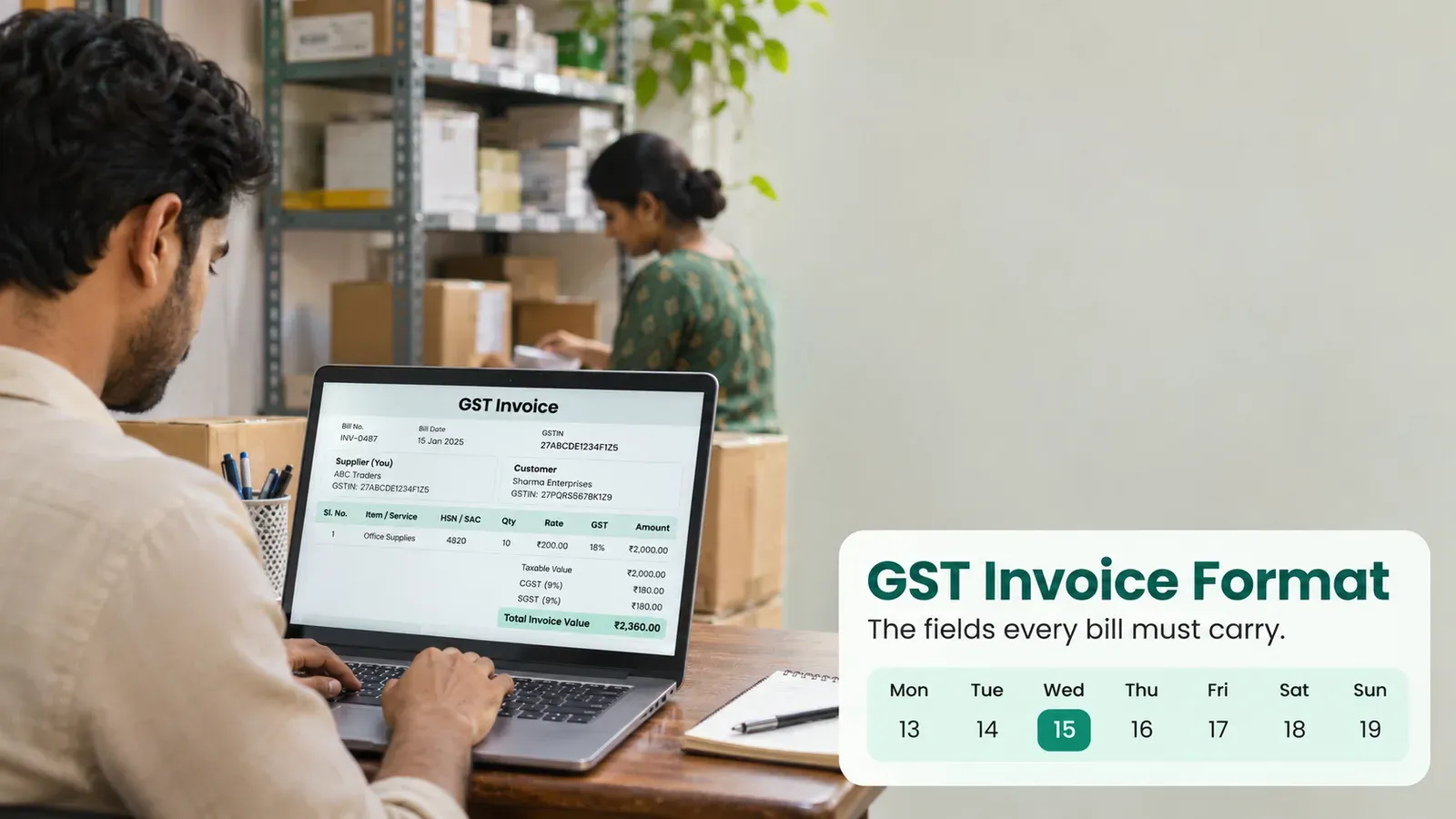
A GST tax invoice in India must carry the details listed in Rule 46 of the CGST Rules, 2017. In short: who is selling, who is buying, what was sold, its HSN or SAC code, the taxable value, the rate and amount of each tax, and where the supply takes place. Get them right on the first bill and your buyer can claim their input tax credit without a chase.
Key takeaways
- Rule 46 of the CGST Rules sets the fields a tax invoice must carry.
- Your GSTIN, a unique serial number of up to 16 characters and the date come first.
- HSN or SAC codes are needed: 4 digits up to ₹5 crore turnover, 6 digits above it.
- For a sale to another state, show the place of supply and charge IGST.
- A missing or wrong field can hold up your buyer’s input tax credit.
What does Rule 46 ask every tax invoice to show?
Rule 46 sets out the particulars in a fixed list. You do not need to copy its order, but every one that applies to your sale must be on the bill.
| Field | What to write |
|---|---|
| Supplier details | Your name, address and GSTIN |
| Invoice number | A serial number of up to 16 characters, unique for the financial year |
| Date | The date the invoice is issued |
| Buyer details | Name, address and GSTIN or UIN, if the buyer is registered |
| HSN or SAC code | The code for the goods (HSN) or the service (SAC) |
| Description | What was supplied, in plain words |
| Quantity and unit | For goods: how many, and in what unit |
| Total value | The full value of the supply |
| Taxable value | The value after any discount or abatement |
| Tax rate | Each rate: CGST, SGST or UTGST, IGST and any cess |
| Tax amount | The amount charged for each of those taxes |
| Place of supply | The state, with its name, for an inter-state supply |
| Delivery address | Where it differs from the place of supply |
| Reverse charge | Whether tax is payable on reverse charge |
| Signature | Yours or an authorised person’s, or a digital signature |
Businesses that must issue e-invoices also add the QR code that carries the Invoice Reference Number (IRN) from the invoice registration portal.
Getting the invoice number right
The serial number causes more trouble than most owners expect. Rule 46 allows up to 16 characters, using letters, numbers, a hyphen or a slash. It must be consecutive and unique within a financial year.
You may keep more than one series, for example one per branch or one for exports. What you may not do is reuse a number in the same year or leave the series to chance.
A numbering pattern that stays within the limit
INV/25-26/0001 is 14 characters. It shows the series, the financial year and a running number, and a new series starts on 1 April.
HSN and SAC codes: how many digits?
Goods are coded with HSN (Harmonised System of Nomenclature) codes and services with SAC (Services Accounting Codes). The number of digits depends on your aggregate turnover in the previous financial year, under Notification 78/2020 Central Tax, in force since 1 April 2021.
| Turnover in the previous year | Invoices to registered buyers | Invoices to unregistered buyers |
|---|---|---|
| Up to ₹5 crore | 4 digits | May be left off |
| Above ₹5 crore | 6 digits | 6 digits |
Pick the code once for each product or service, check it with your tax adviser, and use the same one on every bill. Changing codes from one invoice to the next is a common reason for questions later.
Registered and unregistered buyers
For a registered buyer, their GSTIN is the single most important field on your invoice. It is how the tax you charge shows up in their GSTR-2B, the statement they rely on to claim credit. One wrong character and the credit goes to nobody.
For an unregistered buyer, the rule depends on the value:
- Taxable value of ₹50,000 or more: show their name and address, the delivery address, and the name and code of the state.
- Below ₹50,000: add these details only if the buyer asks you to.
Place of supply: CGST and SGST, or IGST?
The place of supply decides which taxes you charge. When you and the place of supply are in the same state, you charge CGST and SGST (or CGST and UTGST in a union territory). When they are in different states, you charge IGST, and the invoice must name the place of supply and its state.
Write the state name and its two-digit code clearly. If the goods are delivered somewhere other than the place of supply, add the delivery address as well. Moving goods worth more than the set limit also needs an e-way bill, which draws on the same details, so a clean invoice makes that step easier too.
How a missed field holds up input tax credit
Under section 16 of the CGST Act, your buyer can claim input tax credit only when they hold a tax invoice and you have reported it in your outward return (GSTR-1), so that it appears in their GSTR-2B. The time to claim is limited: credit for a financial year must be taken by 30 November of the following year, or the date of the annual return if that comes earlier.
That is why a small slip matters to the buyer:
- Wrong or missing GSTIN: the credit lands on the wrong account, or on none.
- Wrong place of supply: the wrong taxes are charged, and the bill needs a credit note and a fresh invoice.
- Missing HSN or SAC: the invoice is incomplete, and returns or e-invoices may be rejected.
- Late or missing upload: the credit does not show for the buyer until it is reported.
Businesses whose aggregate turnover is above ₹5 crore must issue e-invoices for business sales. From 1 April 2025, those with an aggregate annual turnover of ₹10 crore or more cannot report an invoice on the portal more than 30 days after its date, so fixing errors early matters even more.
Doing it in iCRM
- Customer management. Each customer’s name, billing address, state and GSTIN sit on their record, so you type them once and they flow onto every bill.
- Tax management. Set the GST rates you charge, and apply them to quotes and invoices, so the rate and the tax amount are worked out the same way every time.
- Invoicing. Create the invoice beside the customer and the work, with the description, quantity, value and tax lines in one place.
- Payment tracking. See which invoices are paid, part-paid or still due, so a corrected bill does not get lost.
- Document sharing. Share the invoice, and any credit note that replaces it, with your team and the customer from one place.
Tax management is part of most industries on iCRM in India. Check your own industry’s feature list before you plan around it.
A GST invoice format checklist
- Your name, address and GSTIN are on every invoice.
- The invoice number is unique for the year and no more than 16 characters.
- The date of issue is shown.
- A registered buyer’s GSTIN is checked, character by character.
- An unregistered buyer’s address and state are shown for ₹50,000 or more.
- Every line has its HSN or SAC code, with the right number of digits.
- The description, quantity and unit are clear.
- The taxable value shows any discount.
- Each tax rate and amount is shown separately.
- The place of supply and its state are named for inter-state sales.
- The reverse charge line says yes or no.
- The invoice is signed, or issued electronically.
- The invoice is reported in GSTR-1 on time, and as an e-invoice if you are required to issue them.
Sources
- Rule 46, Tax invoice, CGST Rules, 2017 (CBIC tax information portal)
- Invoice rules (CBIC GST)
- Tax invoice and other documents, GST flyer (GST Council)
- Notification 78/2020 Central Tax, HSN digits on tax invoices (GST Council)
- GSTN advisory: time limit for reporting e-invoices, threshold lowered to AATO of ₹10 crore (Maharashtra GST)
- CBIC lowers turnover threshold for e-invoicing to ₹5 crore from 1 August 2023 (EY tax alert)
- Section 16 of the CGST Act: eligibility, conditions and time limit for input tax credit (GST Gyaan)
Related articles
-
How manufacturers can manage dealer and distributor enquiries
Put every dealer and distributor enquiry from fairs, IndiaMART and calls in one list, qualify it with five questions and follow it to a first order.
- Checklist
- 2 tables
- 6 questions answered
-
Part 2: How to collect overdue payments from clients in India
Remind before the due date, follow a polite schedule after it, send a final notice by day 45, then file on the MSME ODR portal if you are a micro or small unit.
- Checklist
- 2 tables
- 6 questions answered
-
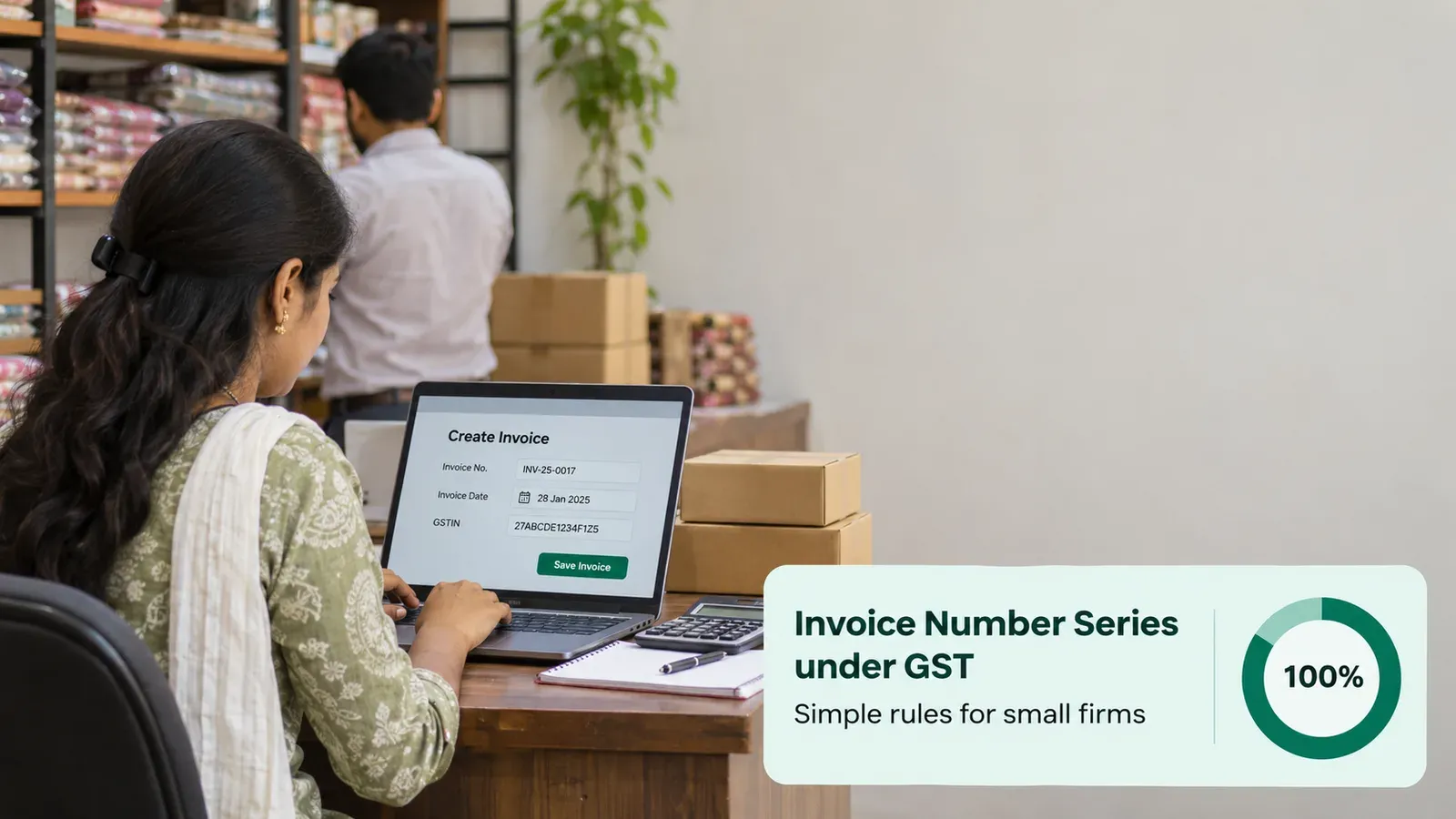
Part 3: Invoice number series rules under GST for small firms
Under GST an invoice number has up to 16 characters, runs in one or more series and is never repeated in a financial year. Start a fresh series each April.
- Checklist
- 2 tables
- 6 questions answered
Recognized with numerous awards
Support, security, uptime and results, with the figures behind each badge.












FAQ
Frequently asked questions
Straight answers to what people ask most about iCRM.
Set up for your industry
Pick yours and its features come ready.
- Farm Businesses
- Automotive Dealers
- Consulting Firms
- Online Retail
- Education Institutes
- Energy Companies
- Financial Services
- Healthcare Clinics
- Hospitality Businesses
- Law Firms
- Logistics Companies
- Manufacturing Companies
- Media Agencies
- Nonprofit Organisations
- Real Estate
- Technology Companies
-
Which rule sets the GST invoice format in India?
Rule 46 of the Central Goods and Services Tax Rules, 2017. It lists the details a tax invoice issued under section 31 of the CGST Act must carry, such as the supplier's GSTIN, a serial number, the date, HSN or SAC codes, the taxable value, the tax rate and amount, and the place of supply for inter-state sales.
-
How long can a GST invoice number be?
Up to 16 characters. It may use letters, numbers, hyphens and slashes, may run in one or more series, and must be unique for each financial year. Many businesses start a fresh series on 1 April.
-
How many HSN digits do I need on my invoice?
Since 1 April 2021, a business with aggregate turnover up to ₹5 crore in the previous year shows 4 digits on invoices to registered buyers, and may leave them off invoices to unregistered buyers. Above ₹5 crore, it shows 6 digits on every tax invoice.
-
Do I need the address of an unregistered customer?
Yes, when the taxable value is ₹50,000 or more. Then the invoice carries the buyer's name and address, the delivery address, and the name and code of the state. Below that amount you add them only if the customer asks.
-
Can a wrong invoice stop my buyer claiming input tax credit?
It can. A buyer can claim credit only when they hold a valid tax invoice and the supplier has reported it in their outward return, so it shows in the buyer's GSTR-2B. A missing GSTIN, a wrong state or a gap in the details can delay or block the claim until it is put right.
-
Does a computer-made invoice need a signature?
Rule 46 asks for the signature or digital signature of the supplier or an authorised person. A proviso relaxes this for invoices issued electronically under the Information Technology Act, 2000. If in doubt, ask your tax adviser how it applies to your own bills.
Get started with iCRM
Leads, quotes, work, invoices and payments in one app, set up for the way your industry works.
- 99% Uptime guarantee
- ISO ISO-aligned security
- 24/7 Response support
- GDPR GDPR compliant
- SSL SSL encrypted
-
16
Industries Each with its own features
-
47
Features Across those industries
-
11
Areas of work From leads to payments
-
3
Editions India, France and UAE