Industry insights
FPO buyer order management: orders, deliveries and payments
Keep each buyer's enquiry, order, delivery notes and payment due in one record, so your FPO knows what was promised, what was sent and what is still owed.
Written by The iCRM team
Published 7 min read
- 1 record For every buyer order
- 4 stages Enquiry, order, delivery, payment
- 45 days Longest agreed term under MSMED Act
- 0.1% TDS On large purchases of goods
On this page
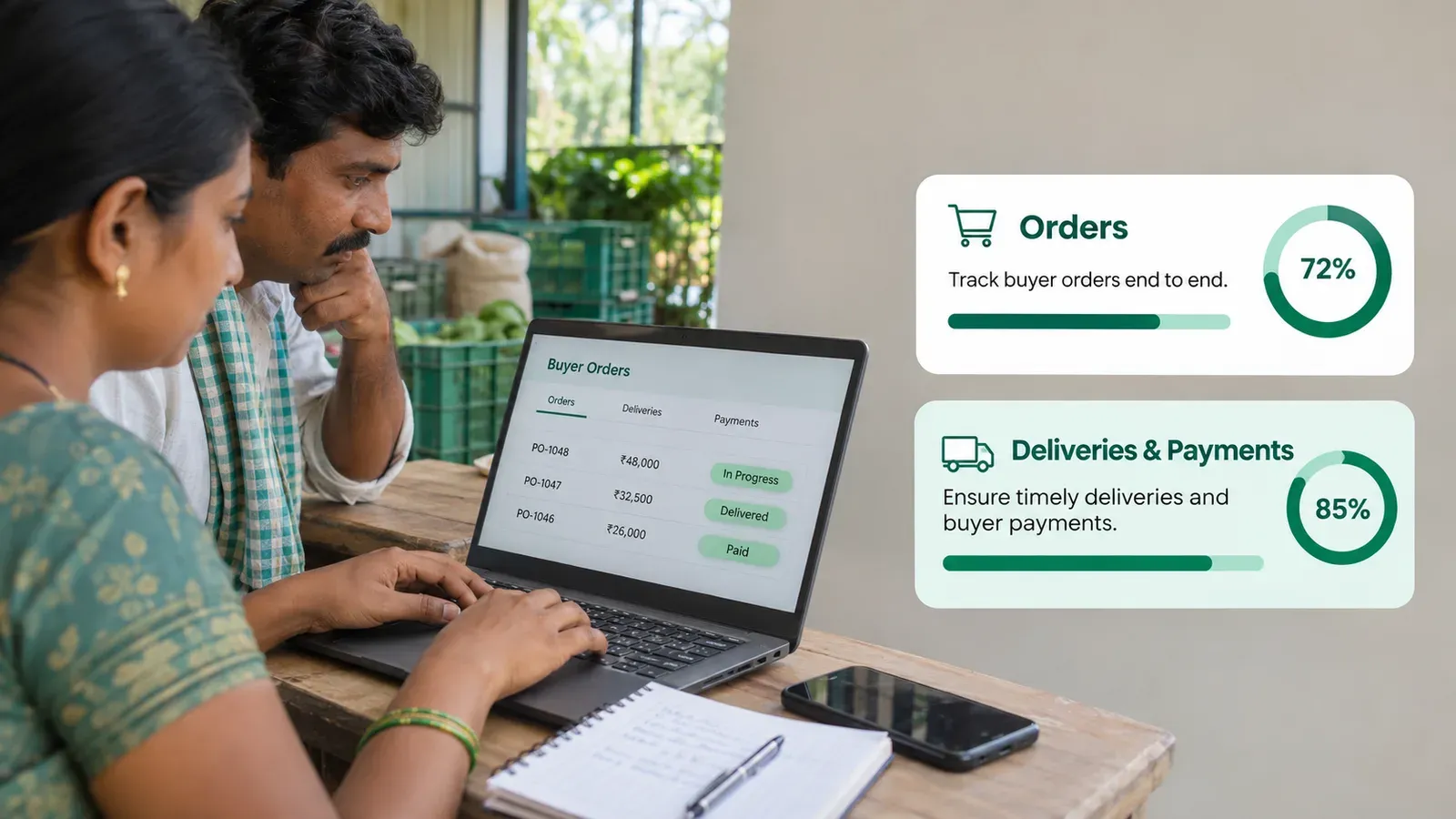
FPO buyer order management means keeping every buyer’s enquiry, order, delivery note and payment due in one record. When a processor, exporter or retail chain calls, anyone in your farmer producer organisation can then say what was agreed, what was sent and what is still owed. This guide sets out a simple way to do it.
Key takeaways
- Give every buyer order one record, from the first enquiry to the last payment.
- Write the agreed grade, quantity, price, delivery date and payment term on the order.
- Record each delivery against the order: sent, accepted, short or rejected.
- Put a due date on every invoice, and note any TDS the buyer deducts.
- Share the record with your staff and board, so the work does not sit with one person.
Why buyer orders get lost in an FPO
Many FPOs now sell to processors, exporters, millers and retail chains, not only at the mandi. These buyers ask for samples, grades, lab reports, fixed delivery slots and their own payment terms. The government’s scheme to form and promote 10,000 FPOs has helped many new organisations start, and many of them are learning this work as they go.
The trouble is rarely the farming. It is the paperwork between the farm gate and the buyer’s account. An enquiry comes on WhatsApp, the rate is agreed on a call, the weighbridge slip is in the driver’s pocket and the invoice is in the accountant’s laptop. When the buyer pays less than expected, nobody can quickly show why.
One record per order fixes most of this. It holds the whole story in one place, in the order it happened.
What one buyer order record should hold
Think of the record as four stages. Each stage adds a few facts, and none of them should live only in someone’s phone.
| Stage | What to record | Who usually adds it |
|---|---|---|
| Enquiry | Buyer, crop, grade, quantity, place, date needed, sample sent | Sales or CEO |
| Order | Agreed price, quantity, quality terms, delivery schedule, payment term | CEO or board member |
| Delivery | Vehicle, date, quantity sent, weighbridge slip, quantity accepted, rejections | Collection centre staff |
| Payment | Invoice number, amount, due date, amount received, TDS deducted, balance | Accountant |
Keep the buyer’s details on the record too: the person who orders, the person who checks quality and the person who pays. In a large company these are often three different people.
A short note on the order is better than a long memory
Write down the terms you agreed, even when you trust the buyer. “Moisture up to 12%, rejections returned at buyer’s cost, payment in 30 days” takes a minute to type and saves a long argument later.
Invoices, GSTIN and e-way bills
The tax side depends on what your FPO sells and how it is set up. Keep the points below general, and check your own case with a tax adviser.
- GST registration. Section 23 of the CGST Act says an agriculturist selling produce from their own cultivation is not liable to register. An FPO is a separate body, usually a producer company or a cooperative, and its position depends on its goods. Unprocessed produce is often exempt, while packed, branded or processed goods and some services can be taxable.
- Tax invoice or bill of supply. A registered FPO selling taxable goods issues a tax invoice with its GSTIN, the buyer’s GSTIN and the tax. For exempt goods, a registered supplier issues a bill of supply instead.
- E-way bills. Goods listed in the annexure to rule 138 of the CGST Rules, such as many fresh vegetables, need no e-way bill whatever their value. Other goods usually need one when the consignment is worth more than 50,000 rupees. A mixed load can still need one. Carry the invoice or bill of supply with every vehicle.
Keep the invoice, the e-way bill number where there is one, and the delivery slip on the same order record. When the buyer queries a load, everything is there.
Payments due, TDS and the 45-day rule
Payment is where most FPOs lose sleep. Members want their money quickly, and buyers often pay late.
Put a due date on every invoice. Work it out from the term on the order, and check the list of what is due each week.
Know why a payment may come in short. Under the Income-tax Act 2025, in force from 1 April 2026, a buyer may deduct TDS of 0.1% on purchases of goods above 50 lakh rupees from one seller in a year. This was section 194Q under the old Act. The deduction is credited against your FPO’s PAN. Record it on the order, so the balance shows correctly.
Use the MSMED Act where it applies. If your FPO is registered as a micro or small enterprise, section 15 of the MSMED Act generally requires the buyer to pay on the agreed date, and the agreed term cannot be longer than 45 days. Late payment can carry interest under the Act. Ask your adviser whether your registration covers this kind of sale.
| Payment check | When | What to do |
|---|---|---|
| Invoice raised | Day of delivery | Add the due date and send it to the buyer’s accounts contact |
| Reminder | A few days before the due date | Call or message the person who pays |
| Due date | On the day | Match the receipt to the invoice and note any TDS |
| Overdue | After the due date | Escalate to the buyer’s manager and record each call |
Members’ data and the DPDP Act
Your order records also hold members’ names, phone numbers and sometimes bank details for passing on payments. The Digital Personal Data Protection Act 2023 sets duties for anyone who handles such data. Keep only what you need, limit who can see it and tell members why you hold it. This is general information, not legal advice.
Doing it in iCRM
These are the iCRM features that agriculture businesses have in India.
- Lead management. Every buyer enquiry goes into one list, with its crop, quantity, owner and next step.
- Customer management and contact management. Each processor, exporter or retailer has one record, with the people who order, check quality and pay.
- Product catalog. Keep your crops and grades with their prices, so orders use the same names every time.
- Estimates. Work out the cost of an order, including collection, grading and transport, before you quote a rate.
- Tax management and invoicing. Set your tax rates once and raise invoices from the customer’s record.
- Payment tracking. See which invoices are paid, part-paid or overdue, and who to call.
- Expense tracking and expense categorization. Log transport, labour and packing costs against the order, so you know what each sale really earned.
- Checklists. Tick off each delivery step: grading done, slip collected, invoice sent.
- Task management and calendar. Give each delivery and follow-up an owner and a date.
- Document sharing. Keep weighbridge slips, lab reports and delivery notes with the order.
- Team messaging and staff management. Keep updates between the office and collection centres in one place, and see who is handling what.
- Offline mode. Update deliveries at a collection centre where the signal is poor.
An FPO buyer order checklist
- Every buyer enquiry has its own record and an owner.
- The agreed grade, quantity, price, delivery date and payment term are written on the order.
- The buyer’s ordering, quality and payment contacts are on the record.
- Each delivery shows the quantity sent, accepted and rejected, with the slip attached.
- The invoice or bill of supply, and the e-way bill where needed, is kept with the order.
- Every invoice has a due date, checked every week.
- Any TDS deducted by the buyer is noted against the invoice.
- Members’ personal data is kept only as needed and seen only by those who need it.
Sources
- Formation and promotion of 10,000 FPOs, Press Information Bureau, Ministry of Agriculture and Farmers Welfare
- GST registration in agriculture: when section 23 saves you, Taxscan
- GST exemption list for e-way bills, Tally Solutions
- GST e-way bill system, official portal
- TDS on purchase of goods under section 393(1), formerly section 194Q, TDSman
- The Micro, Small and Medium Enterprises Development Act, 2006 (Office of the DC MSME, legal framework)
- FAQs: Liability of the buyer under section 15 of the MSMED Act, Taxmann
- The Digital Personal Data Protection Act, 2023, India Code
This guide gives general information, not legal or tax advice. For your own situation, speak to a qualified adviser.
Related articles
-
Part 2: GST credit note rules: when and how to issue one
Under Section 34 you issue a GST credit note when goods come back, a price is cut or a bill was too high, and declare it by 30 November after the year ends.
- Checklist
- 2 tables
- 5 questions answered
-
Part 1: GST invoice format: the fields every bill must carry
A GST tax invoice must carry the fields listed in Rule 46 of the CGST Rules, from GSTIN and serial number to HSN or SAC, tax rate and place of supply.
- Checklist
- 2 tables
- 6 questions answered
-
How manufacturers can manage dealer and distributor enquiries
Put every dealer and distributor enquiry from fairs, IndiaMART and calls in one list, qualify it with five questions and follow it to a first order.
- Checklist
- 2 tables
- 6 questions answered
Recognized with numerous awards
Support, security, uptime and results, with the figures behind each badge.















FAQ
Frequently asked questions
Straight answers to what people ask most about iCRM.
Set up for your industry
Pick yours and its features come ready.
- Farm Businesses
- Automotive Dealers
- Consulting Firms
- Online Retail
- Education Institutes
- Energy Companies
- Financial Services
- Healthcare Clinics
- Hospitality Businesses
- Law Firms
- Logistics Companies
- Manufacturing Companies
- Media Agencies
- Nonprofit Organisations
- Real Estate
- Technology Companies
-
What is FPO buyer order management?
It is the way a farmer producer organisation keeps each buyer's enquiry, confirmed order, deliveries and payments in one record, so the board, staff and members can see what was promised, sent and paid.
-
Does an FPO need a GSTIN to sell to processors and exporters?
It depends on what it sells and how. Unprocessed produce is often exempt, but packed, branded or processed goods and some services can be taxable. Check your own position with a tax adviser before you issue invoices.
-
Is an e-way bill needed for every lorry of produce?
No. Goods listed in the annexure to rule 138 of the CGST Rules, such as many fresh vegetables, need none. Other goods usually need one when the consignment is worth more than 50,000 rupees. Always carry an invoice or bill of supply.
-
Why does the payment from a large buyer come in a little short?
A large buyer may deduct TDS of 0.1% on purchases of goods above 50 lakh rupees in a year. The deduction shows against your PAN, so record it on the order instead of chasing it as an unpaid balance.
-
How many days can a buyer take to pay an FPO?
Whatever you agree, written on the order. If your FPO is registered as a micro or small enterprise, the MSMED Act generally caps the agreed term at 45 days, so put the due date on every invoice.
-
What should we record when a delivery is short or rejected?
The quantity sent, the quantity accepted, the reason given and the buyer's note or photo. Then raise the invoice or a credit note for what was accepted, so the money owed matches the goods.
Get started with iCRM
Leads, quotes, work, invoices and payments in one app, set up for the way your industry works.
- 99% Uptime guarantee
- ISO ISO-aligned security
- 24/7 Response support
- GDPR GDPR compliant
- SSL SSL encrypted
-
16
Industries Each with its own features
-
47
Features Across those industries
-
11
Areas of work From leads to payments
-
3
Editions India, France and UAE