Industry insights
E-way bill rules for transporters: a quick checklist
An e-way bill is needed for most goods over ₹50,000. Validity runs one day per 200 km from Part B, and the driver carries the invoice and the bill.
Written by The iCRM team
Published 8 min read
- 50,000 rupees Consignment value that needs a bill
- 200 km For each day of validity
- 8 hours Window to extend around expiry
- 24 hours To cancel a bill not yet used
On this page
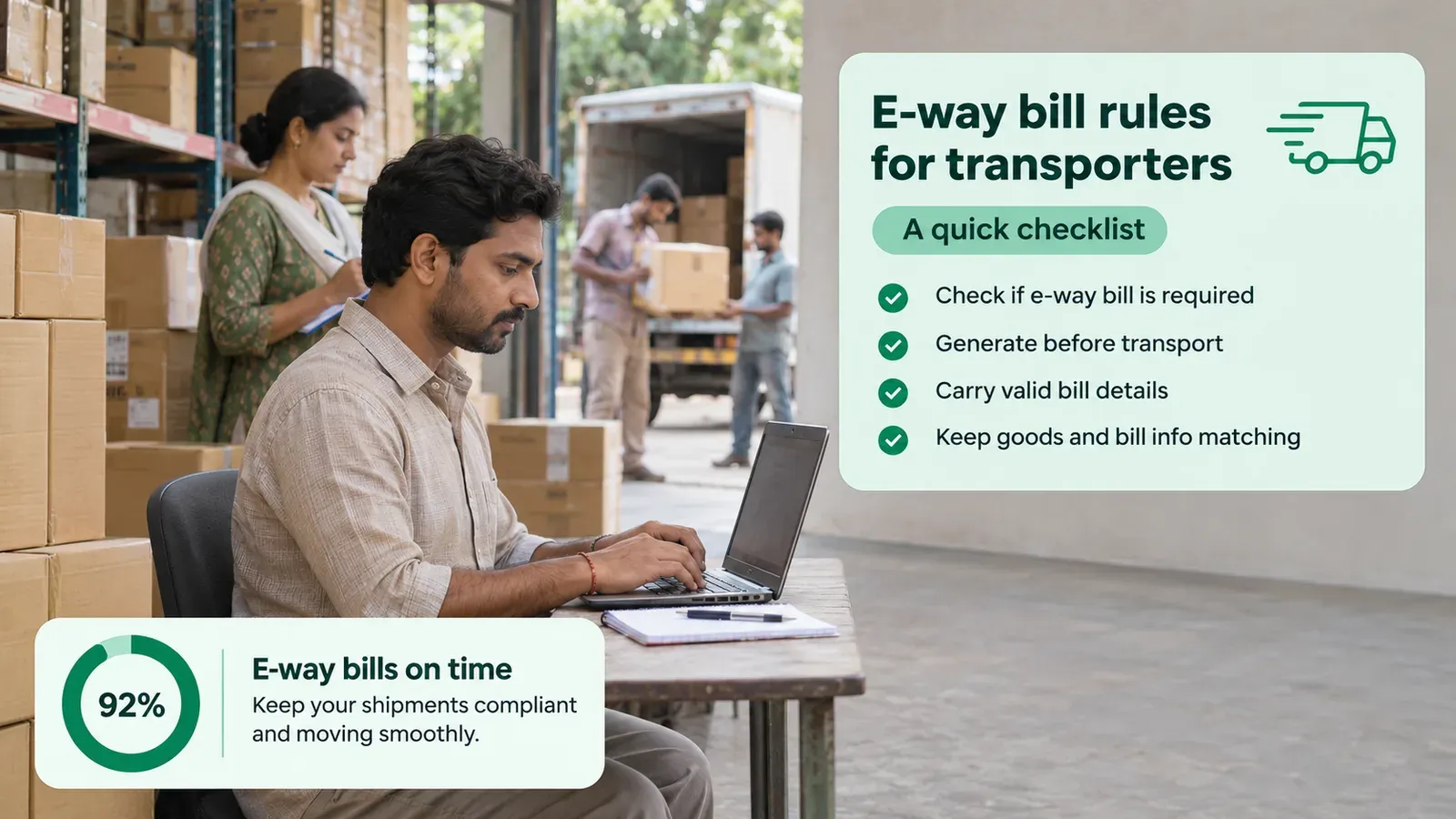
An e-way bill is needed when goods worth more than ₹50,000 move by road, and the transporter shares the duty to make sure one exists before the truck leaves. It is valid for one day for every 200 km, counted from the moment Part B is filled in, and the driver must carry it with the invoice or delivery challan. Get these few points right and most roadside stops end in minutes.
Key takeaways
- Check for a valid e-way bill before you load any consignment above ₹50,000.
- Validity starts with the first Part B entry and runs one day per 200 km.
- Update the vehicle number in Part B every time the goods change vehicle.
- Extend an expiring bill within eight hours of expiry, before or after.
- The driver carries the invoice or challan and the e-way bill, every trip.
When is an e-way bill needed?
An e-way bill is a record, made on the GST e-way bill portal, of goods moving from one place to another. It is needed when the value of a consignment is more than ₹50,000, and that covers more than sales. Returns, goods sent for job work, transfers between your own branches and goods bought from unregistered sellers can all need one.
For movement between states, the ₹50,000 limit is the same across India. For movement inside a state, each state can set its own limit, and some have set a higher one. Before you treat a local trip as exempt, check the rule of the state where the goods are moving.
Some goods and trips do not need a bill at all, for example goods carried in a non-motorised vehicle, a passenger’s personal luggage and certain listed goods. These lists are specific, so check the goods’ HSN code against them instead of assuming.
Who generates it?
The supplier usually generates the e-way bill, or the recipient if the supplier has not. If neither has done it, the transporter must generate it from the invoice or delivery challan before the goods move. A transporter who is not registered under GST can enrol on the portal and get a transporter ID to do this work.
In practice, the simplest rule for your booking desk is this: no valid e-way bill number, no loading.
How long is an e-way bill valid?
Validity depends on the distance and on the kind of cargo. It starts from the date and time of the first entry in Part B, the part that holds the vehicle details, and each day ends at midnight.
| Distance | Normal cargo | Over-dimensional cargo |
|---|---|---|
| Up to 200 km | 1 day | For every 20 km, 1 day |
| 201 to 400 km | 2 days | For every 20 km, 1 day |
| 401 to 600 km | 3 days | For every 20 km, 1 day |
| Each further 200 km or part | 1 more day | For every 20 km, 1 day |
Two dates matter beyond the trip itself. Since 1 January 2025, a bill can only be generated for a document dated in the last 180 days. And however many times a bill is extended, the total cannot go beyond 360 days from the day it was generated.
Extending a bill that is about to run out
Trucks break down, roads close and goods wait at hubs. If the goods cannot reach in time, the transporter can extend the bill, giving the reason and the place where the goods are now. The extension can be asked for in a window of eight hours before or after the bill expires.
Do not wait for the window to close. A bill that has expired while the goods are on the road is treated very much like having no bill at all.
Part B: keep the vehicle number right
Part A holds the details of the goods: the GSTINs of the supplier and recipient, the place of delivery, the document number and date, the value and the HSN code. Part B holds the vehicle number.
The transporter has three things to watch in Part B:
- Fill it before the goods move. Without Part B the bill is not ready for the road. Where the distance from the supplier to the transporter’s place is under 50 km within the same state, Part B may be left out for that first leg, but Part A is still needed.
- Update it whenever the vehicle changes. After a breakdown, at a hub or on trans-shipment, enter the new vehicle number before the goods move again. The validity does not restart when you do.
- Use a consolidated e-way bill for mixed loads. When one vehicle carries several consignments, each with its own bill, the transporter can make one consolidated e-way bill (form EWB-02) for the trip.
A bill can be cancelled within 24 hours of being generated if the goods have not moved or the details are wrong, as long as it has not been checked on the road. The recipient can also reject a bill made in their name, usually within 72 hours.
Since 1 April 2025, every user of the e-way bill portal must log in with multi-factor authentication, a one-time code sent to the registered mobile number. Make sure the person who updates Part B at night or at a hub has their phone with them.
What papers must the driver carry?
When an officer stops a vehicle, the driver is asked for two things:
- The supply document: the tax invoice, bill of supply or delivery challan for the goods.
- The e-way bill: a printed copy, or its number, or the bill mapped to the vehicle’s RFID tag where that applies.
Keep the documents in the cab, in order, and keep a copy of each on the driver’s phone. When a bill is updated during the trip, the driver should have the new vehicle number and the latest validity date, not the first one.
| Check | Before loading | During the trip |
|---|---|---|
| E-way bill number | Valid and matches the invoice | Validity date not passed |
| Part B | Correct vehicle number | Updated after any change of vehicle |
| Documents | Invoice or challan in the cab | Copies on the driver’s phone |
| Mixed load | Consolidated bill made | Every bill on it still valid |
What happens if the papers are wrong?
If goods move without a valid e-way bill, the goods and the vehicle can be detained under section 129 of the CGST Act, and released only once the tax and penalty are paid. Courts have upheld detention where a bill had expired or the new vehicle was not updated after trans-shipment.
The rules do give some room for honest mistakes. A CBIC circular says that where goods have both an invoice and an e-way bill, detention should not be started for a minor clerical error, such as one or two wrong digits in a PIN code or a small spelling mistake in a name. Even so, the time lost at the roadside costs money, so it is better to check the details before the truck leaves.
A bill checked at the loading bay saves an hour at the checkpost.
The iCRM team
Doing it in iCRM
iCRM does not generate e-way bills; that is done on the GST e-way bill portal. What it does is keep the facts your team needs for every trip in one place.
- Customer management and shipping address management. Each customer’s GSTIN, contacts and every delivery address sit on their record, so the details on the invoice and the bill match.
- Invoicing and tax management. Raise the invoice with the right GST in the same place as the customer, so the document the driver carries is ready.
- Document sharing. Keep the invoice, challan and e-way bill copy on the job, and share them with the driver, the team or the customer.
- Task management and automated reminders. Set a task for each trip and a reminder before a bill’s validity runs out, so the extension is asked for in time.
- Document expiry tracking. Know when your vehicles’ and drivers’ own papers, such as permits, are due to run out.
- Team messaging and offline mode. The driver and the desk stay in touch about vehicle changes, and records can be updated where the signal is weak.
An e-way bill checklist for transporters
- Check the value: over ₹50,000, or the state’s own limit inside a state.
- Confirm a valid e-way bill number before loading.
- Make sure Part A matches the invoice: GSTINs, value, HSN and delivery place.
- Fill Part B with the right vehicle number before the goods move.
- Work out the validity: one day per 200 km, ending at midnight.
- Make a consolidated e-way bill for a mixed load.
- Update Part B every time the goods change vehicle.
- Set a reminder to extend in the eight hours around expiry.
- Give the driver the invoice or challan and the e-way bill, with copies on the phone.
- Cancel a wrong bill within 24 hours, before it is used.
Sources
- GST e-way bill system, official portal
- Rule 138 of the CGST Rules, 2017 (text)
- ClearTax: e-way bill validity and distance
- ClearTax: new time limit for e-way bill generation and extension
- Taxmann: important case laws on e-way bill provisions
- Roado: e-way bill rules in India, a guide for transporters (2026)
Related articles
-
FPO buyer order management: orders, deliveries and payments
Keep each buyer's enquiry, order, delivery notes and payment due in one record, so your FPO knows what was promised, what was sent and what is still owed.
- Checklist
- 2 tables
- 6 questions answered
-
Part 2: GST credit note rules: when and how to issue one
Under Section 34 you issue a GST credit note when goods come back, a price is cut or a bill was too high, and declare it by 30 November after the year ends.
- Checklist
- 2 tables
- 5 questions answered
-
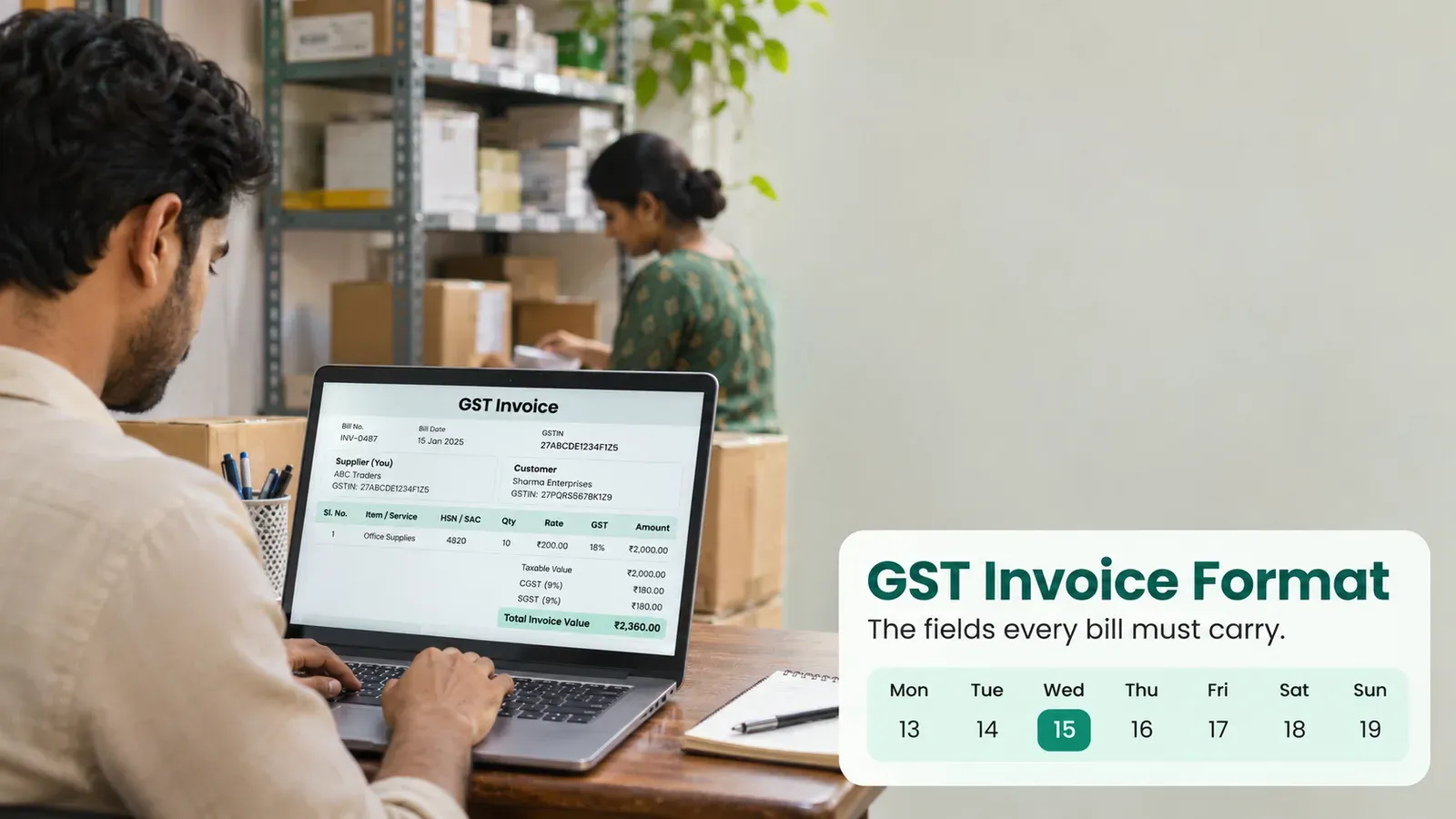
Part 1: GST invoice format: the fields every bill must carry
A GST tax invoice must carry the fields listed in Rule 46 of the CGST Rules, from GSTIN and serial number to HSN or SAC, tax rate and place of supply.
- Checklist
- 2 tables
- 6 questions answered
Recognized with numerous awards
Support, security, uptime and results, with the figures behind each badge.















FAQ
Frequently asked questions
Straight answers to what people ask most about iCRM.
Set up for your industry
Pick yours and its features come ready.
- Farm Businesses
- Automotive Dealers
- Consulting Firms
- Online Retail
- Education Institutes
- Energy Companies
- Financial Services
- Healthcare Clinics
- Hospitality Businesses
- Law Firms
- Logistics Companies
- Manufacturing Companies
- Media Agencies
- Nonprofit Organisations
- Real Estate
- Technology Companies
-
When does a transporter need an e-way bill?
When goods worth more than ₹50,000 move in a vehicle, whether for a sale, a return, job work or a branch transfer. Inter-state the limit is the same everywhere; within a state, check that state's own limit and its list of exempt goods.
-
Who has to generate the e-way bill?
The supplier or the recipient usually generates it. If neither has, the transporter must generate it from the invoice or delivery challan before the goods move, so check for a valid bill before you load.
-
How long is an e-way bill valid?
For normal cargo, one day for every 200 km or part of it, counted from the first Part B entry. Over-dimensional cargo gets one day for every 20 km. A day ends at midnight, not 24 hours after you start.
-
Can I change the vehicle number after the trip starts?
Yes. If the goods move to another vehicle, after a breakdown or at a hub, update the vehicle number in Part B before the goods move again. The validity does not restart when you do this.
-
What papers must the driver carry?
The invoice, bill of supply or delivery challan, and the e-way bill itself, on paper or as its number, or mapped to the vehicle's RFID tag where that applies.
-
What happens if a vehicle is stopped without a valid e-way bill?
The goods and the vehicle can be detained under section 129 of the CGST Act and released only after the tax and penalty are paid. An expired bill is treated much like no bill, so extend it in time.
Get started with iCRM
Leads, quotes, work, invoices and payments in one app, set up for the way your industry works.
- 99% Uptime guarantee
- ISO ISO-aligned security
- 24/7 Response support
- GDPR GDPR compliant
- SSL SSL encrypted
-
16
Industries Each with its own features
-
47
Features Across those industries
-
11
Areas of work From leads to payments
-
3
Editions India, France and UAE