Industry insights
Return and refund process for an online store in India
Publish a clear return policy, log every request, issue a GST credit note against the original invoice and record each refund until the money reaches the buyer.
Written by The iCRM team
Published 8 min read
- 48 hours To acknowledge a consumer complaint
- 1 month To resolve a consumer complaint
- 30 November Last date to declare a credit note
- 5 steps From return request to closed refund
On this page
- Key takeaways
- What the law asks of an online seller
- Step 1: write a return policy buyers can follow
- Step 2: log every request the day it comes in
- Step 3: check the goods and decide
- Step 4: issue a GST credit note against the original invoice
- Step 5: send the refund and record it
- Doing it in iCRM
- A return and refund checklist
- Sources
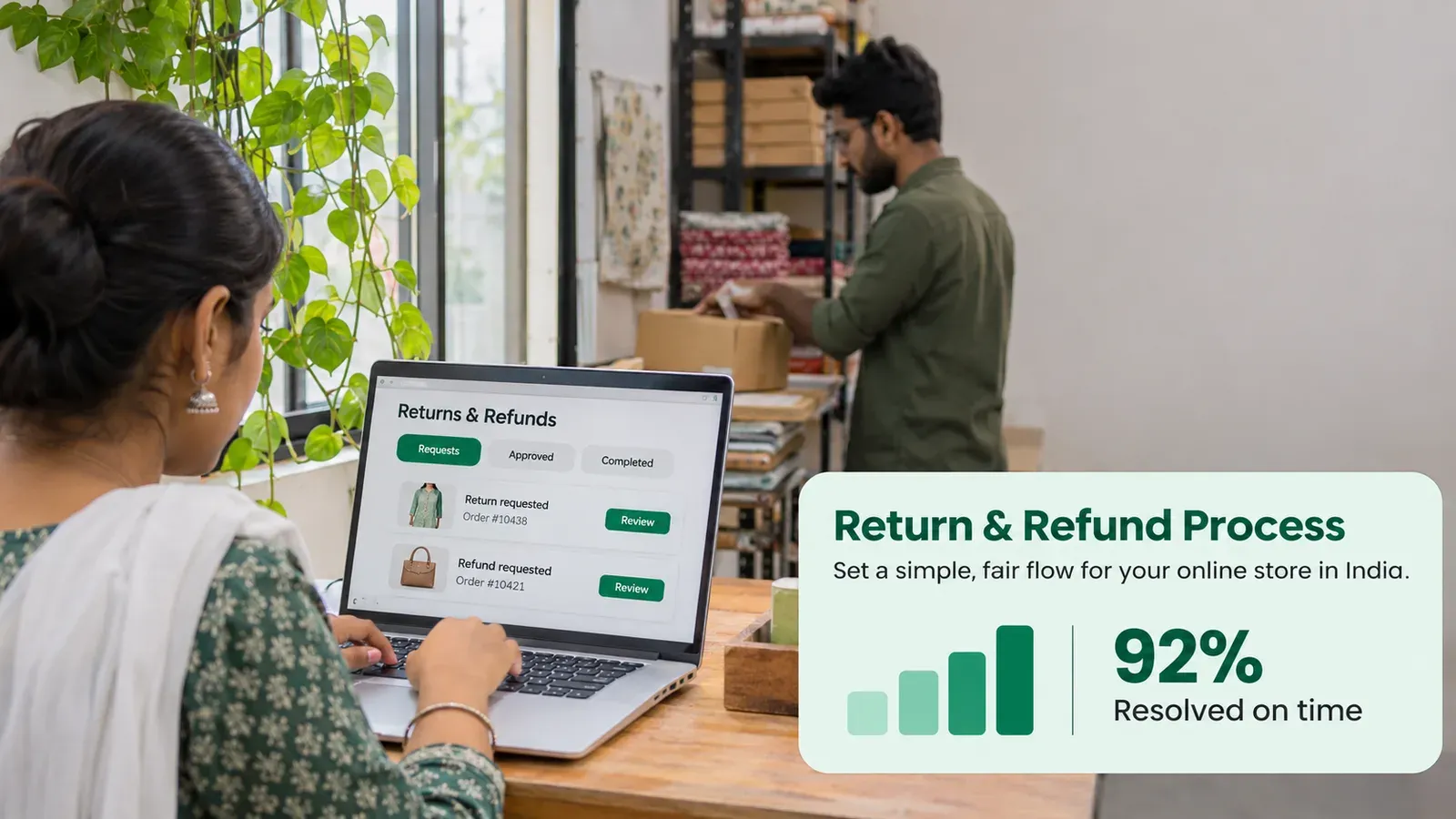
A clear return and refund process for an online store in India has five steps: publish the policy, log each request, check the goods, issue a GST credit note against the original invoice, and record the refund until the money reaches the buyer. Most sellers who lose track of returns skip the last two. The money is agreed, then nobody sends it, or it is sent and the tax is never corrected.
Key takeaways
- Write your return terms down and show them before the buyer orders.
- You cannot refuse a refund for goods that are defective, not as described or delivered late.
- Each accepted return needs a credit note tied to the original invoice.
- Record each refund with its amount, method, date and reference.
- Give every open return an owner and a next date.
What the law asks of an online seller
The Consumer Protection (E-Commerce) Rules, 2020 apply to goods and services sold online in India, whether you sell on your own website or through a marketplace. They sit under the Consumer Protection Act, 2019.
For returns and refunds, the main points are these:
- Show your terms. Sellers must give clear information on returns, refunds, exchanges, warranty, delivery and shipping costs, so the buyer can read them before buying.
- Do not refuse fair returns. A seller cannot refuse to take back goods, or refuse a refund, when the goods are defective, deficient, spurious, not as advertised, or delivered late against the stated schedule. A delay caused by force majeure is the exception.
- Pay accepted refunds on time. Refunds that have been accepted should be paid within a reasonable period, as the Reserve Bank of India or other law prescribes.
- Handle complaints. The rules ask for a grievance officer who acknowledges a consumer complaint within 48 hours and resolves it within one month of receiving it.
These rules set a floor, not your whole policy. For goods that arrive as described, you can decide your own window and conditions, as long as you say so clearly. If you sell through a marketplace, check its own policy as well, since it may ask for more. When a case is unclear, take advice from a lawyer or your chartered accountant.
Step 1: write a return policy buyers can follow
A short policy saves arguments later. It should answer the questions a buyer will ask before they click buy.
| Point | What to decide | Example wording |
|---|---|---|
| What can be returned | Items that cannot come back, such as opened personal care goods | “Innerwear and opened cosmetics cannot be returned unless faulty.” |
| Time window | How many days after delivery | “Request a return within 7 days of delivery.” |
| Condition | Unused, with tags, in original packing | “Send it back unused, with tags and the box.” |
| Return shipping | Who pays, and when | “We pay return shipping if the item is faulty or wrong.” |
| Refund method | Back to the original payment, or by UPI for cash on delivery | “Refunds go to your original payment method.” |
| Refund time | When the money leaves after the goods are checked | “We send the refund within 3 working days of checking.” |
| Complaints | Who to contact | “Write to our grievance officer at the address below.” |
The example wording is only a start. Choose numbers you can keep every week, not on your best week.
Step 2: log every request the day it comes in
Returns arrive by email, chat, phone and marketplace messages. If each one sits in a different inbox, some will be missed.
Put every request in one list, with:
- the order and invoice number;
- the reason the buyer gives;
- photos, if the item is damaged or wrong;
- the person who owns the return;
- the next date something must happen.
Reply the same day, even if only to say what happens next. A buyer who hears nothing is the one who files a complaint.
Step 3: check the goods and decide
When the parcel comes back, check it against the reason given. Note its condition and the date it arrived. Then decide: full refund, part refund, exchange or a reasoned refusal.
If you refuse, explain why in plain words and point to the line in your policy. Remember that a fault, a wrong item or a late delivery is not a fair ground for refusal under the rules.
Step 4: issue a GST credit note against the original invoice
Once you accept a return, do not cancel or edit the original tax invoice. Under section 34 of the CGST Act, you issue a credit note against it. The credit note reduces the taxable value and the tax you charged on the sale.
A credit note should carry, among other details:
- your name, address and GSTIN;
- its own serial number and date;
- the number and date of the original invoice;
- the taxable value and tax being reduced;
- the buyer’s name and, if registered, their GSTIN.
You then declare the credit note in your GST return. It must be declared no later than 30 November following the end of the financial year in which the sale was made, or the date you file the annual return, whichever comes first. Miss that date and you cannot reduce the tax on that sale. Many sellers raise credit notes at the end of each month so none slip past the deadline. Ask your accountant how your returns software reports them.
Step 5: send the refund and record it
This is where money is most often lost. A refund is agreed, the credit note is made, and then the transfer waits on someone’s to-do list.
Record each refund against the invoice and credit note it belongs to:
| What to record | Why it matters |
|---|---|
| Amount refunded | Part refunds are common when one item in an order comes back |
| Method | Original card or wallet, UPI or bank transfer for cash on delivery |
| Date sent | Shows you paid within the time your policy promises |
| Transaction reference | Answers “I have not received it” in one message |
| Who sent it | Stops the same refund going out twice |
Bank and card refunds can take a few days to reach the buyer after you send them. Tell the buyer the date you sent the money and the reference, so they can check with their bank.
The buyer’s details on these records are personal data. The Digital Personal Data Protection Act, 2023 asks you to keep personal data safe and use it only for its purpose, so limit who can see bank and UPI details.
Doing it in iCRM
These features are part of iCRM for online retail in India:
- Customer management. Each buyer’s details, orders and returns sit on one record, so anyone can see the whole story.
- Customer support chat. Return requests and questions stay with the buyer, and open conversations are easy to find.
- Invoicing and tax management. Invoices carry the GST rate you set, so the tax on each item is clear when goods come back.
- Credit notes. Raise a credit note against the original invoice, which stays as it was, and keep both on one record.
- Refund management. Record each refund on its invoice with the amount and method, and keep agreed refunds in view until they are sent.
- Payment tracking. See what has been paid and what is still due, invoice by invoice.
- Task management. Give each open return an owner and a due date.
- Role-based permissions. Decide which staff can see buyers’ payment details and who can mark a refund as sent.
A return and refund checklist
- The return policy is on the site and shown before checkout.
- Faulty, wrong and late items are always accepted back.
- Every request is logged the day it arrives, with an owner.
- Each complaint is acknowledged within 48 hours.
- Returned goods are checked and their condition noted.
- Every accepted return has a credit note against the original invoice.
- Credit notes are declared well before 30 November of the next year.
- Each refund is recorded with its amount, method, date and reference.
- Buyers’ bank and UPI details are seen only by the people who need them.
- Agreed refunds still not sent are reviewed every week.
Sources
- The Consumer Protection (E-Commerce) Rules, 2020: a summary, IndiaLaw
- Stricter regulations on e-commerce: the Consumer Protection (E-Commerce) Rules, 2020, Khaitan and Co
- Consumer complaints against e-commerce platforms, Nyaaya
- Section 34: understanding credit notes in GST, TaxGuru
- Adjustment of tax liability and refund through a GST credit note, TaxGuru
Related articles
-

RFQ tracking for manufacturers: from enquiry to purchase order
Log every RFQ with its drawings, specs, revisions, owner and the buyer's decision date, so job shops quoting many buyers at once never let one slip.
- Checklist
- 3 tables
- 6 questions answered
-

Part 2: Site visit follow-up: turning property visits into bookings
Thank the buyer within the hour, send the cost sheet the same day, plan a second visit for the family and ask for the booking amount within ten days.
- Checklist
- 2 tables
- 6 questions answered
-

Solar lead management: from site survey to installation
Track every rooftop solar lead through seven stages, from enquiry and site survey to quote, PM Surya Ghar papers, installation and net metering.
- Checklist
- 2 tables
- 6 questions answered
Recognized with numerous awards
Support, security, uptime and results, with the figures behind each badge.
















FAQ
Frequently asked questions
Straight answers to what people ask most about iCRM.
Set up for your industry
Pick yours and its features come ready.
- Farm Businesses
- Automotive Dealers
- Consulting Firms
- Online Retail
- Education Institutes
- Energy Companies
- Financial Services
- Healthcare Clinics
- Hospitality Businesses
- Law Firms
- Logistics Companies
- Manufacturing Companies
- Media Agencies
- Nonprofit Organisations
- Real Estate
- Technology Companies
-
Can an online seller in India refuse a return?
A seller can set its own return policy for goods that are as described. But under the Consumer Protection (E-Commerce) Rules, 2020, a seller cannot refuse to take back goods, or refuse a refund, when they are defective, deficient, spurious, not as advertised or delivered late, unless the delay was due to force majeure.
-
Do I need to issue a GST credit note when a customer returns goods?
Yes, if you want to reduce the tax you declared on the original sale. Under section 34 of the CGST Act, you issue a credit note against the original tax invoice and declare it in your return. It must be declared by 30 November after the end of the financial year of the sale, or the date of your annual return, whichever is earlier.
-
How quickly must an online store refund a customer?
The e-commerce rules ask for accepted refunds to be paid within a reasonable time, in the way the Reserve Bank of India or other law prescribes. They do not set one number of days for every case, so publish your own timeline in your policy and keep to it.
-
What should a return and refund policy say?
Which items can be returned, the time window, the condition goods must be in, who pays for return shipping, how the refund is paid and how long it takes, and how to raise a complaint. The rules ask sellers to make these terms clear to buyers before they order.
-
How do I refund a cash on delivery order?
Ask the buyer for a way to receive the money, such as a UPI ID or bank account, and record it with the return. Note the amount, date and reference of the transfer against the order, so you can show the refund was made.
-
What records should I keep for each refund?
The order and invoice number, the reason for the return, the date the goods came back and their condition, the credit note number, and the amount, method, date and reference of the refund. Keep them with the customer so anyone can answer a follow-up.
Get started with iCRM
Leads, quotes, work, invoices and payments in one app, set up for the way your industry works.
- 99% Uptime guarantee
- ISO ISO-aligned security
- 24/7 Response support
- GDPR GDPR compliant
- SSL SSL encrypted
-
16
Industries Each with its own features
-
47
Features Across those industries
-
11
Areas of work From leads to payments
-
3
Editions India, France and UAE