Industry insights
Retainer invoices with GST for consultants in India
Bill a monthly retainer with 18 percent GST on a tax invoice by its due date, issue a receipt voucher for advance fees and track the TDS your client deducts.
Written by The iCRM team
Published 7 min read
- 18 percent GST on most consulting fees
- 30 days To issue an invoice after supply
- 10 percent TDS on professional fees, 194J
- 50,000 rupees Yearly 194J threshold per payee
On this page
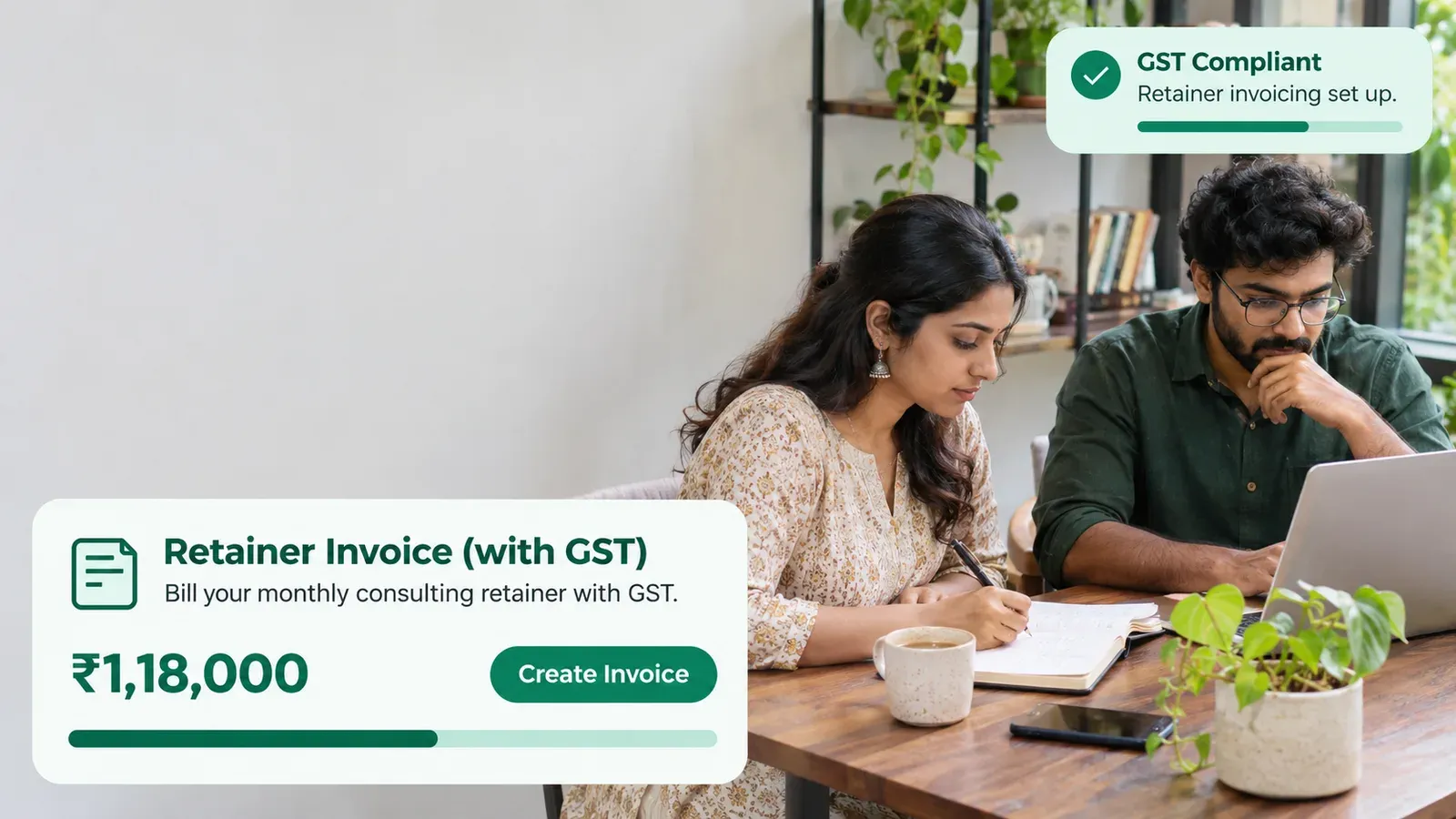
A monthly retainer is the steadiest income a consultant can have, but only when each month is billed properly. In India that means a GST tax invoice at 18 percent for most consulting work, issued by the date the contract says payment is due, with any advance covered by a receipt voucher and the client’s TDS tracked against each invoice.
Key takeaways
- Most consulting fees carry 18 percent GST: CGST and SGST in your state, IGST outside it.
- A monthly retainer is usually a continuous supply: invoice on or before each payment due date.
- GST on services is due on an advance when it is received, so issue a receipt voucher.
- Clients deduct TDS under section 194J, usually 10 percent on professional fees, on the fee without GST.
- Match the TDS each quarter with Form 26AS so your credit is not lost.
What does GST on a retainer look like?
Consulting services fall under heading 9983 of the services classification, and most are taxed at 18 percent. The split depends on where your client is.
| Client location | Tax on the invoice | Example on a 1,00,000 rupee fee |
|---|---|---|
| Same state as you | CGST 9 percent and SGST 9 percent | 9,000 + 9,000 rupees |
| Another state | IGST 18 percent | 18,000 rupees |
| Outside India | Export of services, under LUT or with IGST | Zero rated if the conditions are met |
Each tax invoice needs the usual details: your GSTIN, the client’s GSTIN, a serial number unique for the financial year, the date, the SAC code, the taxable value, the rate and amount of each tax, and the place of supply. Put the retainer period on the invoice too, such as “Advisory retainer, November 2026”, so both sides can match it to the contract.
If your aggregate turnover crosses the limit for e-invoicing, your business-to-business invoices also need to be reported on the invoice registration portal. Check your position with your chartered accountant each year.
When is each month’s invoice due?
A tax invoice for services is normally due within 30 days of the service being supplied. A retainer is different: when you agree a fixed fee each month over a period of more than three months, it is treated as a continuous supply of services.
For a continuous supply, the invoice follows the contract:
- If the contract fixes a payment due date, issue the invoice on or before that date.
- If it ties payment to a milestone, issue it on or before the date the milestone is completed.
- If it says nothing about payment, issue it on or before the date payment is received.
This is why the engagement letter matters. Write the due date in plain words, such as “the fee for each month is due on the 1st of that month”, and invoice on that rhythm every month.
| Retainer step | When | Document |
|---|---|---|
| Advance received before the month | On receipt | Receipt voucher with GST |
| Fee for the month falls due | On or before the due date | Tax invoice, advance adjusted |
| Client pays less TDS | On receipt | Payment entry, TDS receivable |
| Quarter ends | After the client files its TDS return | Check Form 26AS |
| Engagement ends early | When the advance is returned | Refund voucher |
Is GST due on advance retainer fees?
For services, yes. The time of supply is the earlier of the invoice date and the date you receive payment. If a client pays three months of retainer in advance, GST on that amount is due in the month you receive it, even though the work has not started.
The relief that removed GST on advances in 2017 applies to goods only, not services.
When you receive an advance without an invoice, issue a receipt voucher. It carries the client’s details, a description of the service, the amount received, the rate and the tax. When you raise the tax invoice for the month, show the advance already taxed and adjust it, so the same tax is not paid twice.
If the engagement ends and you return part of the advance, issue a refund voucher. That lets the tax already paid on the unused amount be adjusted.
How does TDS under section 194J affect what you receive?
Most business clients in India deduct tax at source when they pay professional fees. Under section 194J the rate is usually 10 percent for professional services, and 2 percent for fees for technical services. From 1 April 2025 the yearly threshold per payee was raised to 50,000 rupees. The Income-tax Act, 2025 has renumbered these provisions from April 2026, so your client’s forms may show a new section number for the same deduction.
The CBDT has said that where GST is shown separately on the invoice, TDS is worked out on the fee without the GST.
| Line | Amount |
|---|---|
| Retainer fee | 1,00,000 rupees |
| GST at 18 percent | 18,000 rupees |
| Invoice total | 1,18,000 rupees |
| TDS at 10 percent on the fee | 10,000 rupees |
| Amount you receive | 1,08,000 rupees |
The 10,000 rupees is not lost. It is credited against your income tax once the client files its TDS return. Record it as a TDS receivable against the invoice and close it only when it appears in your Form 26AS. A gap you find in the first quarter is far easier to chase than one found at year end.
Note that GST is due on the full invoice value. TDS reduces the cash you receive, not the GST you owe.
Keeping every month on time
Retainers slip for simple reasons: an invoice raised late because the month was busy, a payment received without a voucher, a TDS credit nobody checked. A small routine prevents most of it.
- Raise the invoice on the same day each month, by the due date in the contract.
- Send it with a short note of the work covered, so approval is quick.
- Log each payment the day it arrives, with the TDS deducted.
- Check unpaid invoices every week and follow up politely.
If you are registered as a micro or small enterprise under Udyam, your clients are expected to pay within the agreed time, and no later than 45 days where an agreement exists. Put your Udyam number on your invoices so clients know it applies.
Doing it in iCRM
These are the iCRM features consultants have in India that help with a monthly retainer.
- Proposals and e-signatures. Send the engagement proposal with the fee, the payment due date and the retainer period, and have the client sign it online.
- Invoicing. Raise each month’s invoice for the client, with the retainer period described, from the same record as the engagement.
- Tax management. Keep each client’s GST details and the tax on each invoice in one place for your accountant.
- Payment tracking. Record each payment against its invoice, including the amount deducted as TDS, so the open balance is always plain.
- Task management and calendar. Set a recurring task for each retainer’s invoice date and a quarterly reminder to check Form 26AS.
- Client dashboard and client messaging. Keep the engagement’s work, invoices and messages together, so the client sees what each month covered.
- Expense tracking. Record expenses on the engagement, so reimbursable costs are ready to add to the right invoice.
A retainer invoice checklist
- The engagement letter states the monthly fee and its payment due date.
- Each invoice carries both GSTINs, the SAC code, the place of supply and the retainer period.
- CGST and SGST, or IGST, is charged correctly for the client’s state.
- Every advance received has a receipt voucher, adjusted on the next invoice.
- The invoice is issued on or before the due date in the contract.
- Each payment is logged with the TDS deducted.
- TDS is checked against Form 26AS every quarter.
- Your Udyam number is on the invoice if you are registered.
- A refund voucher is issued if any advance is returned.
Sources
- GST Council: time of supply, GST flyer
- GST on advances received for future supplies, GSTZen
- Receipt voucher under CGST rule 50, GSTZen
- Section 194J: TDS on professional fees and technical services, ClearTax
- Section 194J: TDS on professional and technical fees, TaxGuru
- CBDT Circular 23 of 2017: no TDS on the GST component, ClearTax
- MSMED Act, 2006: delayed payments to micro and small enterprises, India Code
Related articles
-

Return and refund process for an online store in India
Publish a clear return policy, log every request, issue a GST credit note against the original invoice and record each refund until the money reaches the buyer.
- Checklist
- 2 tables
- 6 questions answered
-

RFQ tracking for manufacturers: from enquiry to purchase order
Log every RFQ with its drawings, specs, revisions, owner and the buyer's decision date, so job shops quoting many buyers at once never let one slip.
- Checklist
- 3 tables
- 6 questions answered
-

Part 2: Site visit follow-up: turning property visits into bookings
Thank the buyer within the hour, send the cost sheet the same day, plan a second visit for the family and ask for the booking amount within ten days.
- Checklist
- 2 tables
- 6 questions answered
Recognized with numerous awards
Support, security, uptime and results, with the figures behind each badge.
















FAQ
Frequently asked questions
Straight answers to what people ask most about iCRM.
Set up for your industry
Pick yours and its features come ready.
- Farm Businesses
- Automotive Dealers
- Consulting Firms
- Online Retail
- Education Institutes
- Energy Companies
- Financial Services
- Healthcare Clinics
- Hospitality Businesses
- Law Firms
- Logistics Companies
- Manufacturing Companies
- Media Agencies
- Nonprofit Organisations
- Real Estate
- Technology Companies
-
What GST rate applies to a consulting retainer in India?
Most management and business consulting services are taxed at 18 percent GST. Charge CGST and SGST at 9 percent each for a client in your own state, or IGST at 18 percent for a client in another state.
-
Is GST due on an advance retainer fee for services?
Yes. For services, GST is due when the advance is received if that comes before the invoice. Issue a receipt voucher for the advance and adjust it against the tax invoice when the work is billed.
-
When should I raise each month's retainer invoice?
For a retainer with fixed monthly payments, treat it as a continuous supply and raise the invoice on or before the date payment is due under the contract. Fix that date in the engagement letter.
-
Does my client deduct TDS on the GST part of my invoice?
Where GST is shown separately on the invoice, the CBDT has said TDS is worked out on the fee without the GST. Show the GST on its own line to keep this clear.
-
How do I treat the TDS my client deducts from my retainer?
Record the amount received and the TDS as a receivable against the invoice. Check it against your Form 26AS each quarter and claim the credit when you file your income tax return.
-
Do I need an e-way bill for consulting work?
No. E-way bills are for moving goods. A retainer for advice or services does not need one, though e-invoicing applies if your turnover crosses the limit set for it.
Get started with iCRM
Leads, quotes, work, invoices and payments in one app, set up for the way your industry works.
- 99% Uptime guarantee
- ISO ISO-aligned security
- 24/7 Response support
- GDPR GDPR compliant
- SSL SSL encrypted
-
16
Industries Each with its own features
-
47
Features Across those industries
-
11
Areas of work From leads to payments
-
3
Editions India, France and UAE