Industry insights
Consulting proposal format: how to write one that wins
A consulting proposal that wins is short and follows one format the client can check fast. Problem, scope, timeline, fees with GST, milestones and sign-off.
Written by The iCRM team
Published 8 min read
- 7 parts In a proposal that clients read
- 18 percent GST on most consulting fees
- 10 percent TDS on professional fees, 194J
- 45 days Longest MSME credit by agreement
On this page
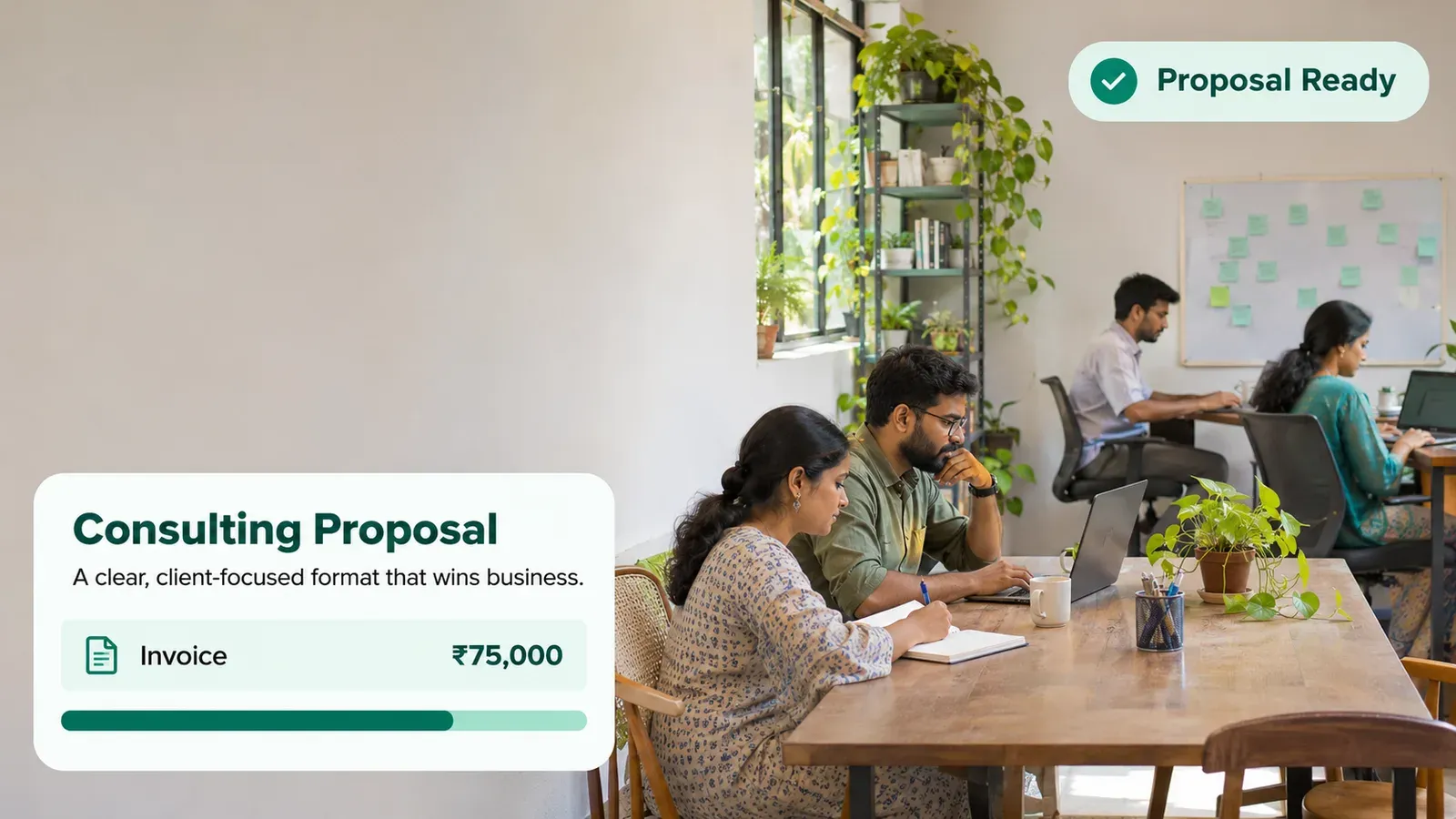
A consulting proposal that wins is short, follows the same format every time and answers the client’s questions in the order they ask them. Start with their problem in their own words, then the scope, the timeline, the fees with GST, the payment milestones and a simple way to say yes. Everything else goes in an annexure.
Key takeaways
- Use one format: problem, outcome, scope, timeline, fees, milestones, acceptance.
- Write the problem in the client’s words, from your first meeting.
- Show the fee, GST and total on separate lines, and mention TDS.
- Tie each payment to a piece of work the client can see.
- Make accepting one step, and book the follow-up before you send it.
Why long proposals go unanswered
Most consultants lose proposals to silence, not to a rival. The client opens a 20-page document, sees a company history, a method diagram and team profiles, and puts it aside to read “properly” later. Later rarely comes.
A decision maker usually wants three answers: do you understand my problem, what will I get, and what will it cost. If those answers sit on page 14, the proposal waits. If they sit on page one, the client can say yes the same day.
The fix is not a cleverer proposal. It is the same clear format, every time, so the client always knows where to look.
The seven parts of a consulting proposal format
Keep each part short. One page for the first three together is a good aim.
| Part | What it answers | How long |
|---|---|---|
| 1. The problem | Do you understand us? | 3 to 5 sentences |
| 2. The outcome | What will change? | 3 bullets |
| 3. The scope | What exactly will you do, and not do? | Half a page |
| 4. The timeline | When will we see each piece? | A short table |
| 5. The fees | What will it cost, with tax? | A short table |
| 6. The milestones | When do we pay, and for what? | A short table |
| 7. Acceptance | How do we say yes? | A few lines and a signature |
1. The problem, in the client’s words
Open with what the client told you, not with your firm. Use their phrases from the meeting: “our dealers in Gujarat reorder late”, “month-end closing takes twelve days”. When they read their own words back, they know you listened.
2. The outcome
Say what will be different at the end. Keep to outcomes you control: a new process written up, a team trained, a report delivered. Do not promise results that depend on the client’s market or staff.
3. The scope, and what is out of scope
List the work in plain bullets. Then add a short “not included” list. This one list prevents most later arguments about extra work. Say how you will handle a change: a short written note, with its own fee and dates, signed before the work starts.
4. The timeline
Give weeks, not exact dates, until the client accepts. Show what the client must provide, and by when, such as data, access or a meeting with their team. Your dates move if theirs do, and the proposal should say so.
| Week | Your work | What the client provides |
|---|---|---|
| 1 | Kick-off and interviews | Names and calendar slots |
| 2 to 3 | Study and analysis | Last 12 months of data |
| 4 | Draft recommendations | Feedback within 5 working days |
| 5 | Final report and handover | Sign-off meeting |
Fees, GST and TDS: the part clients check first
Many clients turn straight to the price. Make it easy to read and correct for India.
Show tax on its own line. Consulting services are generally taxed at 18 percent GST. Show the fee, the GST rate, the GST amount and the total separately. Put your GSTIN and the client’s GSTIN, the SAC code for your service and the place of supply on the proposal, because the tax invoice will need them later. Confirm the right code and rate for your service with your accountant.
Mention TDS. Many business clients must deduct TDS on professional fees under section 194J of the Income Tax Act, at 10 percent for professional services, once the payments for the year cross the threshold (₹50,000 from April 2025). A short line such as “fees are subject to TDS as applicable” avoids a surprise when a ₹2,00,000 milestone arrives a little lighter. Keep your PAN on the proposal so the client can file correctly and you get the credit.
Choose a fee model and explain it in one line. A fixed fee for a defined scope, a monthly retainer or a day rate. Pick one per proposal. Offering three models at once often slows the decision.
| Line | Amount |
|---|---|
| Consulting fee (fixed, as per scope) | ₹4,00,000 |
| GST at 18 percent | ₹72,000 |
| Total | ₹4,72,000 |
The figures are an example only.
Payment milestones that clients accept
Tie each payment to something the client can see. Clients pay faster for a delivered report than for “month two”.
| Milestone | When | Share of fee |
|---|---|---|
| Advance | On acceptance | 30 percent |
| Draft recommendations | End of week 4 | 40 percent |
| Final report and handover | End of week 5 | 30 percent |
State the payment period for each invoice, such as 15 days. If your firm is registered as a micro or small enterprise under the MSMED Act, the buyer must pay within the agreed period, which cannot be more than 45 days from acceptance of the service, or within 15 days where there is no written agreement. Late payment can carry interest, and the MSME Samadhaan portal lets you file a complaint. Add your Udyam registration number to the proposal, so the client knows these rules apply.
Acceptance, data and the follow-up
Make yes one step. End with a short acceptance block: the client’s name, designation, date and signature. An e-signature on the proposal itself is usually faster than printing, signing and scanning. Say how long the proposal is valid, for example 30 days.
Treat client data with care. Consulting work often means employee lists, customer records or sales data. Under the Digital Personal Data Protection Act, 2023, personal data should be used only for the purpose it was shared for and kept safe. Add a line on how you will store client data and when you will return or delete it. Keep it general and let your lawyer review your standard wording.
Book the follow-up before you send. At the end of your meeting, agree a date to discuss the proposal. Then send it within two working days, while the problem is fresh. A proposal with a call already in the calendar rarely disappears.
Doing it in iCRM
These features are part of iCRM for consulting firms in India.
- Proposals. Write each proposal in the same seven-part format, so every client finds the problem and the price in the same place.
- Estimates. Set out the fee, GST and total line by line before it goes into the proposal.
- E-signatures. The client accepts the proposal by signing it online, with no printing or scanning.
- Tax management. Keep GST rates and tax details consistent across proposals and invoices.
- Sales pipeline. See every proposal by stage, from sent to accepted or lost, and which ones have gone quiet.
- Lead management and calendar. Give each enquiry an owner and put the follow-up call on the calendar before the proposal goes out.
- Invoicing and payment tracking. Raise an invoice at each milestone and see what is paid and what is due.
- Document sharing and client messaging. Share the proposal, annexures and reports with the client, and keep the conversation on their record.
A consulting proposal checklist
- The problem is written in the client’s own words.
- The outcome has three bullets you can deliver.
- The scope has an “out of scope” list and a change rule.
- The timeline shows what the client must provide, and when.
- Fee, GST rate, GST amount and total are on separate lines.
- Your GSTIN, PAN, SAC code and place of supply are on it.
- TDS is mentioned.
- Each payment is tied to a visible piece of work.
- Payment terms and your Udyam number are stated, if you are an MSME.
- There is a line on how client data is kept and returned.
- Acceptance is one signature, with a validity date.
- The follow-up call is already in the calendar.
Sources
- CBIC: GST, the Central Board of Indirect Taxes and Customs
- Busy: GST on consultancy services in India
- ClearTax: Section 194J, TDS on professional and technical fees
- Taxscan: TDS and TCS changes from 1 April 2025
- MSME Samadhaan: delayed payment monitoring system
- iPleaders: MSME Samadhaan and delayed payment recovery
- MeitY: the Digital Personal Data Protection Act, 2023
Related articles
-
Donor management for NGOs in India: receipts and follow-ups
Keep one record per donor with their PAN, every gift and its receipt, so Form 10BD is easy in May and every donor is thanked and updated on time.
- Checklist
- 2 tables
- 6 questions answered
-
DPDP Act 2023 for small business: what to do with customer data
The DPDP Act 2023 asks a small business to collect customer data with clear consent, use it for a stated purpose, keep it safe and delete it when done.
- Checklist
- 2 tables
- 6 questions answered
-
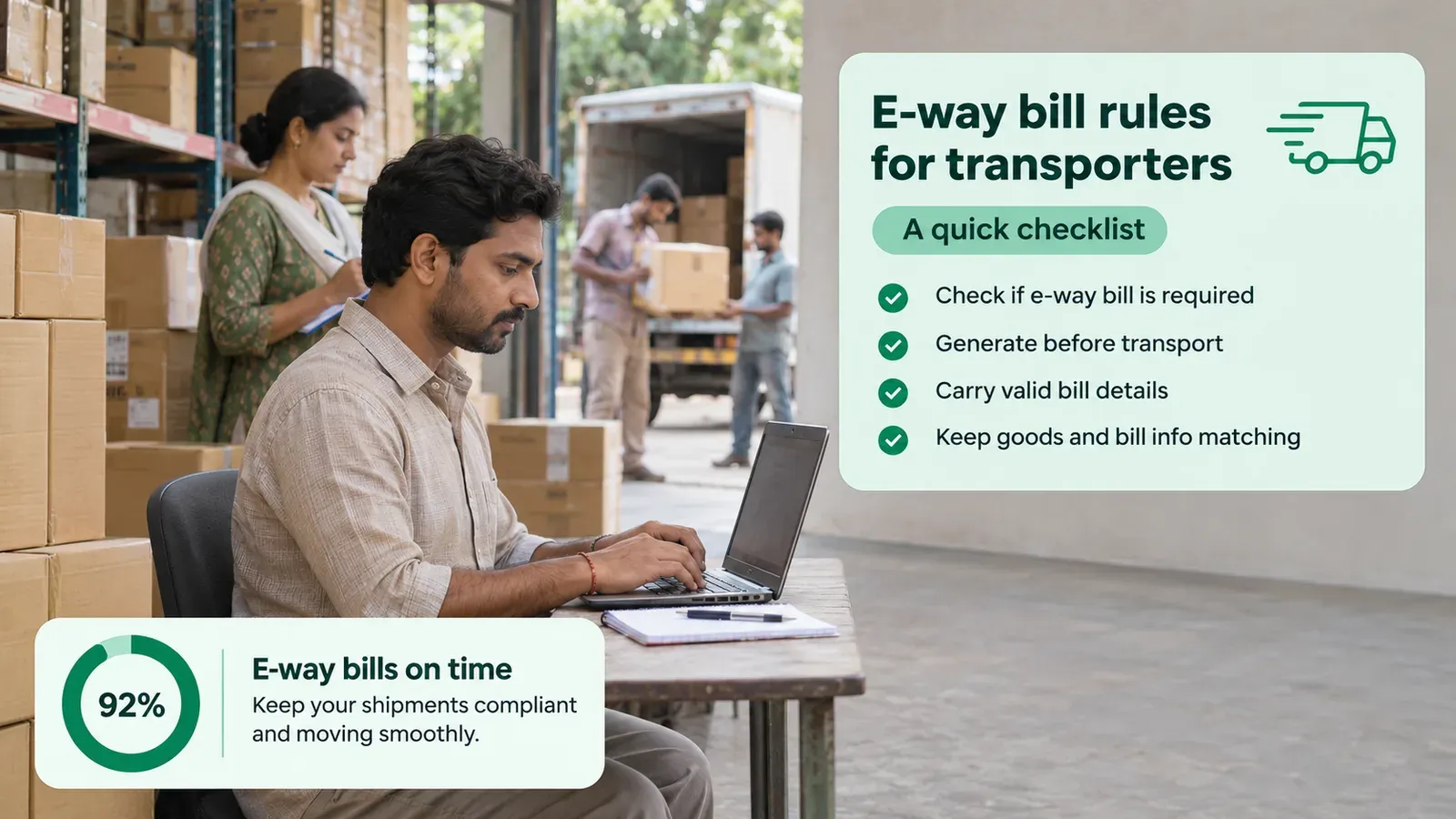
E-way bill rules for transporters: a quick checklist
An e-way bill is needed for most goods over ₹50,000. Validity runs one day per 200 km from Part B, and the driver carries the invoice and the bill.
- Checklist
- 2 tables
- 6 questions answered
Recognized with numerous awards
Support, security, uptime and results, with the figures behind each badge.












FAQ
Frequently asked questions
Straight answers to what people ask most about iCRM.
Set up for your industry
Pick yours and its features come ready.
- Farm Businesses
- Automotive Dealers
- Consulting Firms
- Online Retail
- Education Institutes
- Energy Companies
- Financial Services
- Healthcare Clinics
- Hospitality Businesses
- Law Firms
- Logistics Companies
- Manufacturing Companies
- Media Agencies
- Nonprofit Organisations
- Real Estate
- Technology Companies
-
What is the best consulting proposal format?
Seven short parts in this order. The client's problem, the outcome, the scope, the timeline, the fees with GST, the payment milestones and a clear way to accept. Put the problem and the price where the client can find them in under a minute.
-
How long should a consulting proposal be?
As short as the job allows. For most small and mid-sized engagements, three to five pages is enough. Put detailed method notes and team profiles in an annexure, so the main pages stay easy to read.
-
Should I show GST separately in my consulting proposal?
Yes. Show the fee, the GST rate and the GST amount on separate lines, with the total under them. Consulting services are usually taxed at 18 percent. Check the rate and the SAC code for your service with your accountant.
-
Why does the client deduct TDS from my consulting fee?
Under section 194J of the Income Tax Act, many business clients must deduct TDS on professional fees above a yearly threshold. Mention it in the proposal, so the amount you receive does not surprise you, and keep your PAN on every document.
-
How do I get a consulting proposal accepted faster?
Send it within two working days of the meeting. Make accepting one simple step, such as a signature on the last page. Then agree a date to talk it through before you send it, so the follow-up is already booked.
-
Do the MSME payment rules apply to consultants?
They can. If your firm is registered as a micro or small enterprise, the MSMED Act limits how long a buyer may take to pay you. It is 45 days at most with a written agreement. State your Udyam registration and your payment terms in the proposal.
Get started with iCRM
Leads, quotes, work, invoices and payments in one app, set up for the way your industry works.
- 99% Uptime guarantee
- ISO ISO-aligned security
- 24/7 Response support
- GDPR GDPR compliant
- SSL SSL encrypted
-
16
Industries Each with its own features
-
47
Features Across those industries
-
11
Areas of work From leads to payments
-
3
Editions India, France and UAE