Industry insights
VAT registration threshold UAE: do you need to register?
You must register for VAT once taxable supplies and imports pass AED 375,000 in 12 months, and you may register from AED 187,500.
Written by The iCRM team
Published 7 min read
- 375,000 dirhams Mandatory registration threshold
- 187,500 dirhams Voluntary registration threshold
- 12 months Looked back over, on a rolling basis
- 5 percent Standard UAE VAT rate
On this page
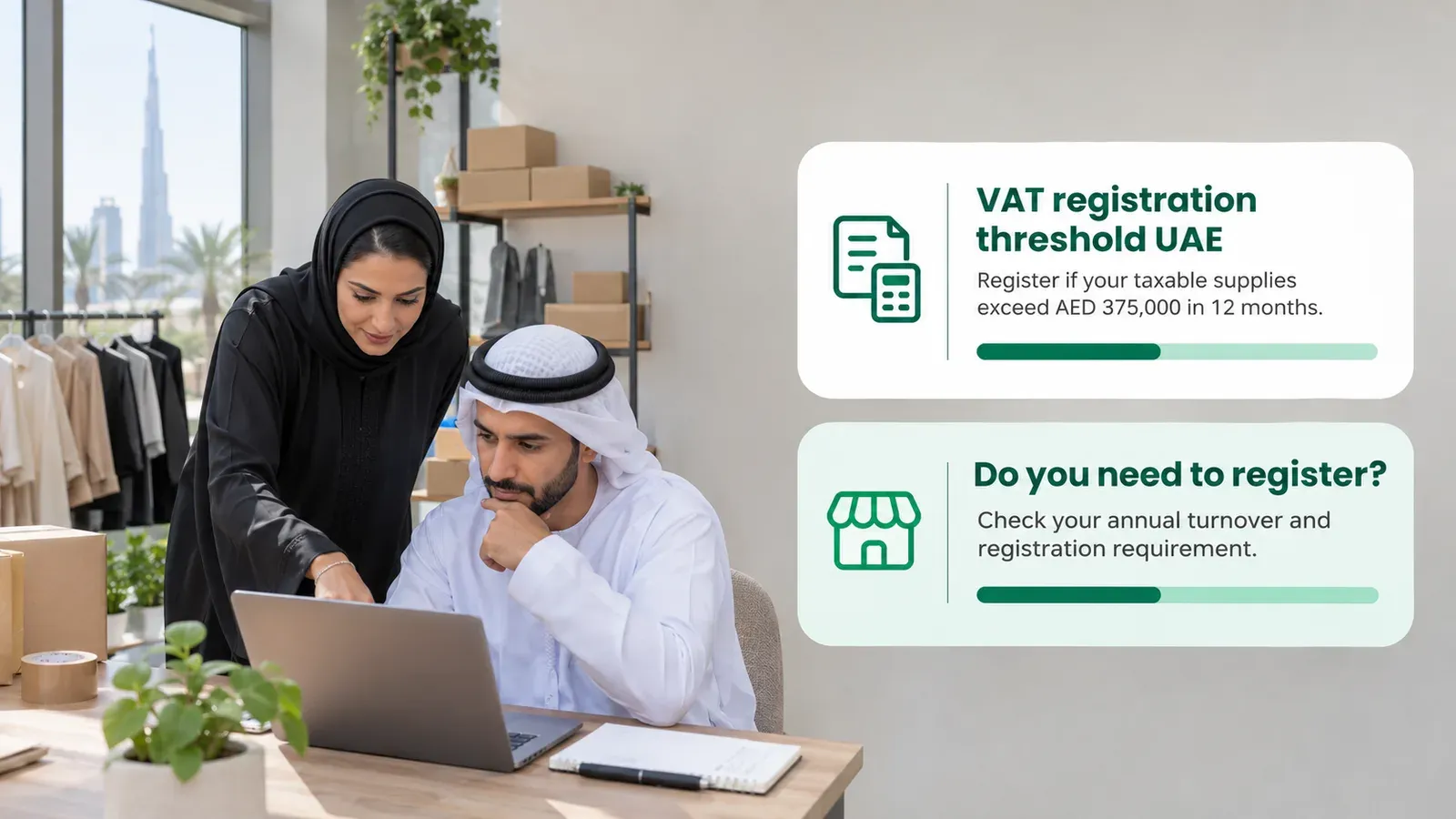
You must register for VAT in the UAE once your taxable supplies and imports pass AED 375,000 over the previous 12 months, or when you expect them to pass that figure in the next 30 days. Below that, you may choose to register once they pass AED 187,500. This guide explains how the count works and what changes on your invoices once you hold a tax registration number.
Key takeaways
- The mandatory threshold is AED 375,000 of taxable supplies and imports.
- The voluntary threshold is AED 187,500, and taxable expenses can count towards it.
- The test is a rolling 12 months looking back, plus the next 30 days looking ahead.
- Exempt supplies do not count towards the threshold.
- Once registered, you charge 5% VAT on standard rated sales and issue proper tax invoices.
What are the two thresholds?
VAT has applied across the UAE since 1 January 2018, at a standard rate of 5%. The Federal Tax Authority (FTA) runs registration, returns and payments.
There are two figures to know. One tells you when you must register. The other tells you when you may.
| Type | Threshold | What is counted | Who it suits |
|---|---|---|---|
| Mandatory | AED 375,000 | Taxable supplies and imports | Any UAE business that passes it |
| Voluntary | AED 187,500 | Taxable supplies and imports, or taxable expenses | Growing businesses and start-ups with costs but few sales |
| Foreign business | No threshold | Any taxable supplies made in the UAE | Businesses not based in the UAE, where no one else accounts for the VAT |
If you pass the mandatory figure, registration is not a choice. Apply promptly through the FTA’s online services. Late registration can bring an administrative penalty, so do not wait for your next accounts.
How is taxable turnover counted?
The count is simpler than it sounds, but two points catch people out.
A rolling 12 months, not the calendar year
The test looks back over the previous 12 months at any point in time. A business with a strong spring may pass the threshold in June, even if January to May on their own look small. Check your running total at the end of every month.
The 30-day look ahead
The test also looks forward. If you sign a large contract today and expect your taxable supplies to pass AED 375,000 within the next 30 days, you must register now. You do not wait until the money comes in.
What goes into the total
- Standard rated supplies: most goods and services sold in the UAE at 5%.
- Zero rated supplies: for example, many exports of goods and services. They are taxable at 0%, so they still count.
- Imports: the value of goods and services you bring into the UAE that would be taxable if supplied there.
What stays out
- Exempt supplies: such as some residential property, bare land, local passenger transport and certain financial services.
- Sales outside the scope of VAT: for example, money you receive that is not a payment for a supply.
If most of your income is exempt, you may stay below the threshold even with a large turnover. If you are unsure how one of your sales is treated, check the FTA’s guides or ask a registered tax agent.
Should you register voluntarily?
Voluntary registration lets you reclaim the VAT you pay on your business costs. That can help a start-up buying equipment, or a business that sells mostly to other VAT registered companies, who can reclaim the VAT you charge them.
It also has a cost. You must charge VAT, issue tax invoices, keep records and file returns on time, the same as any registered business.
| Points for registering early | Points for waiting |
|---|---|
| You reclaim VAT on your costs | Prices rise by 5% for customers who cannot reclaim VAT |
| Business customers often prefer registered suppliers | More paperwork and return deadlines |
| Your systems are ready before you must register | Penalties apply if returns are late |
A business that sells mostly to the public, who cannot reclaim VAT, often waits. A business that sells to other companies, or that has heavy start-up costs, often registers early.
What changes on your invoices once you are registered?
From your registration date, you charge VAT on taxable supplies and issue tax invoices. The FTA’s guide on tax invoices sets out the full list, and you should read it before your first one. In broad terms, a full tax invoice shows:
- The words “Tax Invoice” clearly on it.
- Your name, address and tax registration number (TRN).
- The customer’s name, address and TRN, where they are registered.
- A sequential invoice number and the date it was issued.
- The date of supply, if it differs from the issue date.
- A description of each item, its quantity, unit price and the VAT rate applied.
- Any discount, the total amount and the VAT due, shown in AED.
- The exchange rate used, where you invoice in another currency.
A simplified tax invoice, with fewer details, can be used in some cases, such as sales to customers who are not registered. The FTA’s guide explains when it applies.
Registration brings other habits too:
- Returns: you file VAT returns online for each tax period the FTA gives you, and pay any VAT due.
- Records: you keep your invoices, credit notes and records of costs and VAT so the FTA can check them.
- Prices: decide whether your price lists include VAT or show it on top, and tell your customers.
E-invoicing is on the way
The UAE is introducing a national e-invoicing system, with invoices exchanged through service providers accredited by the Ministry of Finance. It is being rolled out in phases. Check the Ministry of Finance for the dates and rules that apply to your business, and ask your software provider how they will support it.
Doing it in iCRM
- Tax management. Set your VAT rates once, apply the right rate to each item, and see the tax on every invoice.
- Invoicing. Create invoices in the same place you keep your customers, and keep every invoice with its customer.
- Payment tracking. Record payments against invoices and see which are paid, part paid or overdue, so your monthly totals are easy to check.
- Customer management. Keep each customer’s details up to date, including what you need for their tax invoices.
- Automated reminders. Get reminded of follow-ups and due dates, such as your monthly threshold check and return deadlines.
- Document sharing. Keep your trade licence, TRN certificate and other papers with your team in one place.
iCRM helps you keep the figures in order. It does not register you with the FTA or file your returns: you do that through the FTA’s own online services, or through your tax agent.
A VAT registration checklist
- Total your taxable supplies and imports for the last 12 months.
- Leave out exempt supplies and anything outside the scope of VAT.
- Add any large sales you expect in the next 30 days.
- Repeat the check at the end of every month.
- If you pass AED 375,000, apply to the FTA straight away.
- If you pass AED 187,500, decide whether voluntary registration suits you.
- Set up a UAE Pass account to use the FTA’s online services.
- Gather your trade licence, owner details and turnover records.
- Set your 5% rate and invoice layout before your first taxable sale.
- Put your return deadlines in your calendar.
Sources
Related articles
-

AMC contract renewal: quick tips for UAE FM companies
Keep every AMC end date on one list, remind clients 90 days early, send the renewal offer at 60 days and sign before the last visit, so work never stops.
- Checklist
- 1 table
- 5 questions answered
-
Car repair estimate: how UAE garages can write one
A clear car repair estimate lists parts, labour and 5% VAT line by line, and gets the customer's approval before any work starts on the car.
- Checklist
- 2 tables
- 6 questions answered
-
Car service reminders: quick tips for UAE workshops
Record the next due date and mileage at every visit, remind customers two weeks ahead, and make booking the next service one simple reply.
- Checklist
- 1 table
- 5 questions answered
Recognized with numerous awards
Support, security, uptime and results, with the figures behind each badge.








FAQ
Frequently asked questions
Straight answers to what people ask most about iCRM.
Set up for your industry
Pick yours and its features come ready.
- Automotive Dealers
- Beauty Salons
- Construction Companies
- Consulting Firms
- Online Retail
- Event Management
- Facility Management
- Healthcare Clinics
- Hospitality Businesses
- Logistics Companies
- Real Estate
- Travel Agencies
-
What is the VAT registration threshold in the UAE?
A UAE business must register once its taxable supplies and imports pass AED 375,000 over the previous 12 months, or are expected to pass it in the next 30 days. It may register voluntarily from AED 187,500.
-
Is the threshold counted over the calendar year?
No. The test looks back over any rolling 12 months, so check it every month, not once a year. It also looks forward. If you expect to pass the threshold in the next 30 days, you must register.
-
Do exempt sales count towards the threshold?
No. Standard rated and zero rated supplies count, and so do imports. Exempt supplies, such as some residential property and certain financial services, are left out of the count.
-
Can a start-up with no sales register for VAT?
Yes, if its taxable expenses pass AED 187,500 over the previous 12 months, or are expected to in the next 30 days. The Ministry of Finance says this option is meant for start-ups with no turnover yet.
-
What changes on my invoices once I am registered?
You charge VAT on taxable supplies and issue tax invoices that show your tax registration number (TRN), the date, a sequential number, each item's price and the VAT in AED. The FTA's guide on tax invoices sets out every detail.
-
Do foreign businesses have a threshold?
No. A business not based in the UAE that makes taxable supplies there must register whatever their value, when no one else in the UAE is required to account for the VAT on them.
Get started with iCRM
Leads, quotes, work, invoices and payments in one app, set up for the way your industry works.
- 99% Uptime guarantee
- ISO ISO-aligned security
- 24/7 Response support
- GDPR GDPR compliant
- SSL SSL encrypted
-
12
Industries Each with its own features
-
45
Features Across those industries
-
11
Areas of work From leads to payments
-
3
Editions India, France and UAE