Industry insights
Construction project cost tracking for UAE contractors
Track materials, labour and subcontractor costs against the approved quote on every site, each week, so you see a shrinking margin while you can still act.
Written by The iCRM team
Published 8 min read
- 3 cost types Materials, labour, subcontractors
- 1 review Of every job's costs each week
- 80% used Of a cost line before you check it
- 5% VAT Kept apart from the job's cost
On this page
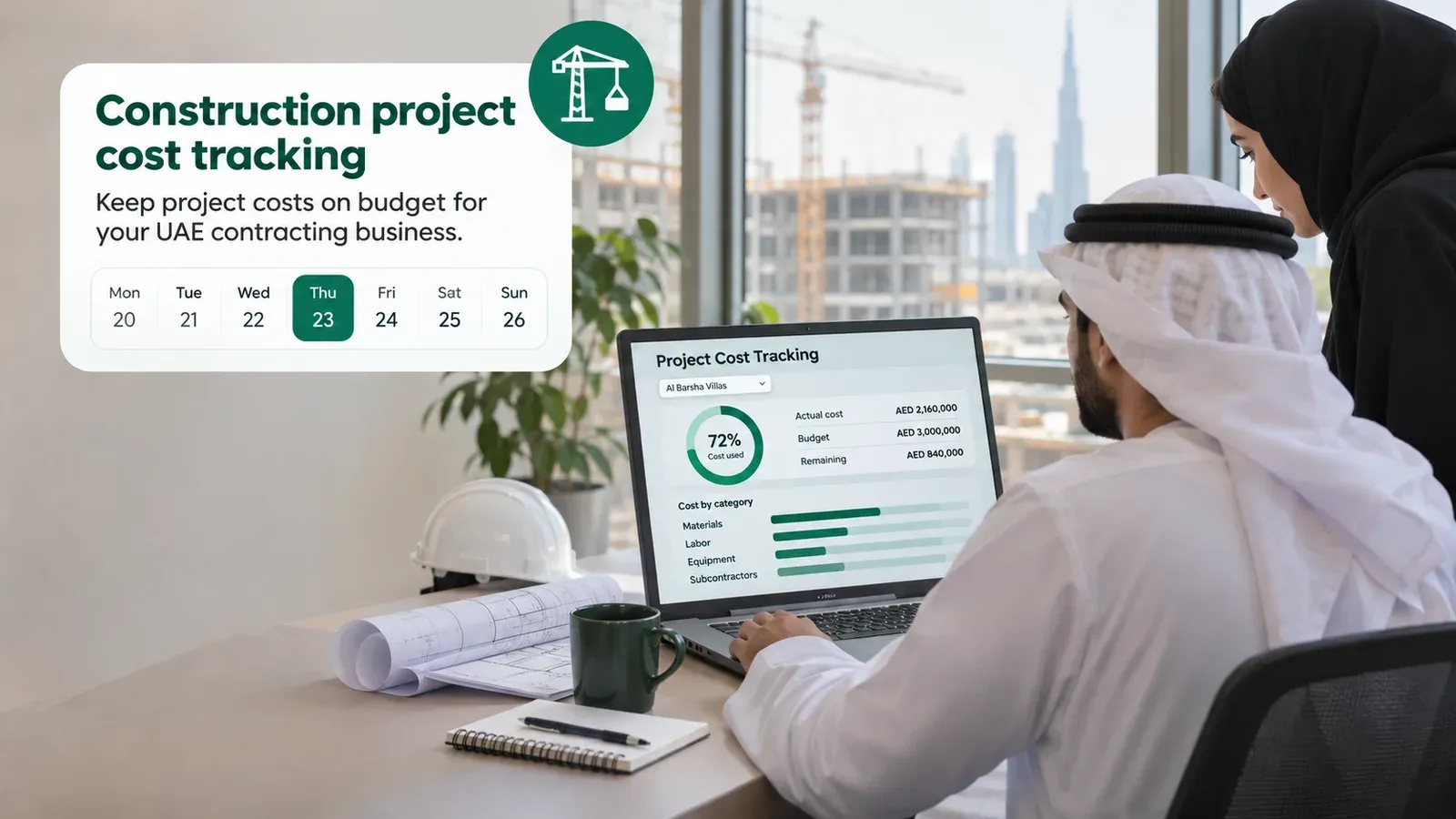
Construction project cost tracking means recording every cost of a job as it happens, under the same lines as the quote the client approved. Do it each week and you see a shrinking margin while there is still time to act, not after the final invoice. This guide is for small and mid-sized UAE contractors running several sites at once.
Key takeaways
- Track costs under the same lines as the approved quote, so the two can be compared.
- Log materials, labour and subcontractor costs on the day, with a job name on each one.
- Keep VAT apart: record costs before VAT if you are registered.
- Review every live job once a week, and check any cost line that passes 80% of its budget.
- Treat each variation as its own line, approved in writing.
Why margins disappear before the job ends
On most small jobs nobody loses money on purpose. The margin leaks away in small amounts: an extra delivery of blockwork, two more days of a labour crew, a subcontractor’s claim for work nobody remembers agreeing.
Each cost looks reasonable on its own. The trouble is that nobody adds them up against the quote until the job is finished. By then the client has paid most of the stages, and there is nothing left to correct.
A contractor running five or six sites at once has the hardest time. The office sees invoices arrive, but not which site they belong to or whether they were planned. The site supervisor knows what was used, but not what was budgeted.
Cost tracking closes that gap. It puts the planned figure and the real figure side by side, job by job.
Start from the approved quote
Your quote is your budget. Before work starts, turn its lines into the job’s cost lines, and give each one the cost you expect, not the price you charge.
Keep the same groups you used to price the job. If you quoted a fit-out in stages, track it in stages. If you quoted by trade, track it by trade.
| Cost line | Quoted price (AED) | Planned cost (AED) | Spent so far (AED) | Used |
|---|---|---|---|---|
| Materials | 120,000 | 92,000 | 61,000 | 66% |
| Own labour | 60,000 | 44,000 | 39,500 | 90% |
| MEP subcontractor | 85,000 | 70,000 | 35,000 | 50% |
| Plant and equipment hire | 15,000 | 11,000 | 4,200 | 38% |
| Site costs and permits | 10,000 | 7,500 | 3,100 | 41% |
The figures above are an example. In this one, own labour has used 90% of its planned cost while the job is about half done. That is the line to look at this week.
Log costs where they happen
A cost recorded weeks later is often recorded wrong, or not at all. The rule is simple: every cost gets a job name and a cost line on the day it is spent.
Materials
Ask suppliers to put your job name or site on every delivery note and tax invoice. Match deliveries against purchase orders before you pay. Returned or unused stock should come off the job’s cost, or move to the next job in writing.
Labour
Record each crew’s days or hours against the job they worked on, not just in the payroll total. If a crew splits a day between two sites, split the cost too. Daily cost per worker, including accommodation and transport where you pay them, is more honest than the wage alone.
Subcontractors
Agree the scope, the price and the payment stages before work starts. Record each claim against the agreed amount, and keep any retention you hold as its own figure. A claim for work outside the agreed scope is a variation, and should be approved before it is paid.
Keep VAT out of your job costs
The standard rate of VAT in the UAE is 5%. If your business is registered for VAT, the VAT you pay on materials and subcontractors can generally be reclaimed, as long as you hold a valid tax invoice from a registered supplier.
That VAT is not a cost of the job. Record each cost before VAT, and keep the VAT on its own. If you mix the two, every job looks about 5% more expensive than it really is.
Check that supplier and subcontractor invoices show the details the Federal Tax Authority requires, such as the words “Tax Invoice”, the supplier’s TRN and the VAT in AED. Keep them with the job. VAT registered businesses generally have to keep their tax records for at least five years.
The UAE is also moving to e-invoicing between businesses. The Ministry of Finance has published the dates and the rules. Clean, consistent records of who you buy from and what you pay will make that change easier.
Review every job once a week
Pick one time each week, for example Sunday afternoon, and go through every live job. It should take minutes per site, not hours, if costs were logged on the day.
For each job, ask four questions:
- Which cost lines have passed 80% of their planned cost?
- How far through the work is that line, in plain terms?
- Is anything spent that was not in the quote?
- Are there variations not yet approved or not yet invoiced?
| Signal | What it usually means | What to do this week |
|---|---|---|
| A line passes 80% with much work left | Waste, rework or a pricing gap | Walk the site with the supervisor |
| Costs with no job name | Logging has slipped | Assign them before the review ends |
| Work done outside the scope | An unrecorded variation | Get written approval and price it |
| Stage finished but not invoiced | Cash waiting on paperwork | Invoice the stage the same day |
Bring the site supervisor into the review. The numbers tell you where to look, and the person on site tells you why.
Track variations as their own lines
Variations are where many UAE fit-out and building jobs win or lose their margin. A client asks for a change on site, the crew does it, and nobody prices it until the final account.
Treat every variation as its own small job. Get it approved in writing, with a price, before the work starts where you can. Add it to the project as a new line with its own planned cost. Invoice it at the next payment stage.
Keeping variations apart lets you see two margins: on the original scope and on the extras. Both should be healthy.
Doing it in iCRM
These are the iCRM features construction businesses have in the UAE:
- Estimates and quote builder. Work out the materials, labour and other costs of a job, then build the quote line by line from them. The same figures become your planned costs.
- Project management. Run each site as a project, with its dates, owners, files and notes together, so you can see where every job stands.
- Expense tracking. Log each cost as it happens and link it to its job, so spending on every site is plain to see.
- Offline mode. Supervisors can update work on site where the signal is poor, and the record carries on once they are back online.
- Tax management. Set your 5% VAT rate once and apply it to quotes and invoices, with the tax shown on each one.
- Invoicing and payment tracking. Invoice each stage and each approved variation, and see which invoices are paid, part paid or still due.
- Staff management and checklists. See who is working on what, and tick off each step on site so the record matches the work.
- Document sharing. Keep delivery notes, supplier invoices and signed variations with the job they belong to.
A construction project cost tracking checklist
- Turn the approved quote into cost lines before work starts.
- Give every cost line a planned cost, not just a price.
- Put a job name and a cost line on every cost, on the day.
- Ask suppliers to show your site on delivery notes and tax invoices.
- Record labour by job, including split days.
- Record subcontractor claims against the agreed amount and retention.
- Record costs before VAT, with the 5% VAT kept apart.
- Keep supplier and subcontractor tax invoices with the job.
- Review every live job once a week with the supervisor.
- Check any line that passes 80% of its planned cost.
- Approve, price and invoice every variation as its own line.
Sources
Related articles
-
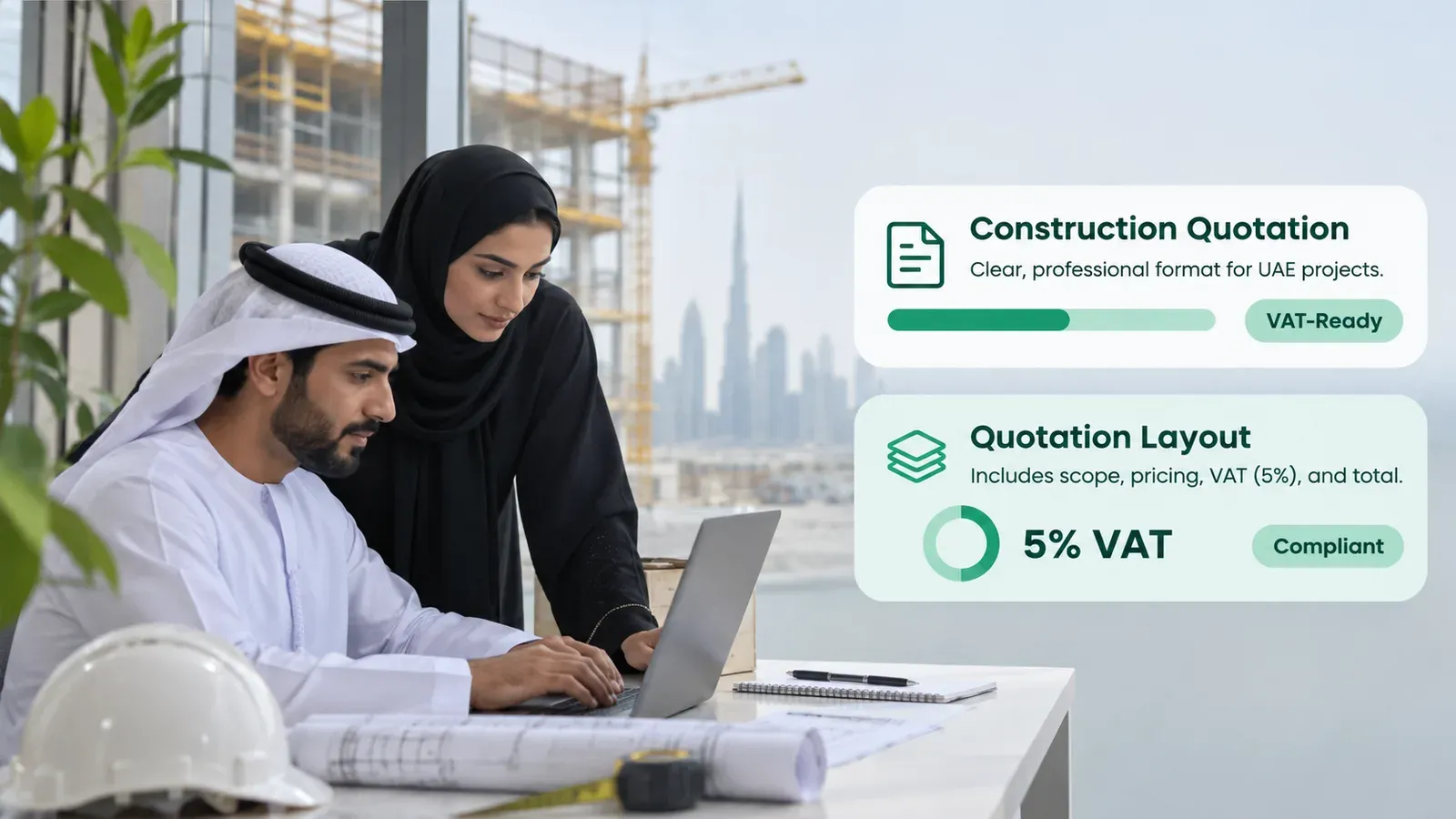
Part 1: Construction quotation format UAE: a clear, VAT-ready layout
A UAE construction quotation that wins approval shows your TRN, a clear scope, priced lines, exclusions, payment stages, a validity date and 5% VAT in AED.
- Checklist
- 3 tables
- 6 questions answered
-

Consulting proposal UAE: from first call to signature
A consulting proposal in the UAE wins on a clear scope, fees with 5% VAT in AED or the client's currency, plain terms and an online signature on the final version.
- Checklist
- 3 tables
- 6 questions answered
-

Credit note VAT UAE: refunds for online stores
When a UAE online store refunds or takes back a taxed sale, it issues a tax credit note within 14 days and reduces its output VAT by the tax on the difference.
- Checklist
- 3 tables
- 6 questions answered
Recognized with numerous awards
Support, security, uptime and results, with the figures behind each badge.














FAQ
Frequently asked questions
Straight answers to what people ask most about iCRM.
Set up for your industry
Pick yours and its features come ready.
- Automotive Dealers
- Beauty Salons
- Construction Companies
- Consulting Firms
- Online Retail
- Event Management
- Facility Management
- Healthcare Clinics
- Hospitality Businesses
- Logistics Companies
- Real Estate
- Travel Agencies
-
What is construction project cost tracking?
It is recording every cost of a job as it happens, under the same lines as the approved quote, so you can compare what you planned to spend with what you have spent, while the job is still running.
-
Which costs should a small contractor track on each job?
Materials, labour and subcontractors first, as they are most of the money. Add plant and equipment hire, transport, permits and site costs as their own lines, so nothing is hidden in a general total.
-
Should I record costs with or without VAT?
If you are registered for VAT, record each cost before VAT and keep the 5% VAT on its own. VAT you can reclaim is not a cost of the job, and mixing it in makes your margin look worse than it is.
-
How often should I compare costs with the quote?
Once a week for every live job, at the same time each week. Monthly reviews find problems too late on short fit-out jobs, where a few weeks can be most of the programme.
-
What should I do when a variation is agreed on site?
Get it approved in writing, add its price and its expected cost to the job as a new line, and keep it apart from the original quote. Then you can see the margin on the original scope and on the extras.
-
How long should I keep supplier and subcontractor invoices?
VAT registered businesses in the UAE generally have to keep their tax records, including tax invoices received, for at least five years. Check the exact period for your business with your tax adviser.
Get started with iCRM
Leads, quotes, work, invoices and payments in one app, set up for the way your industry works.
- 99% Uptime guarantee
- ISO ISO-aligned security
- 24/7 Response support
- GDPR GDPR compliant
- SSL SSL encrypted
-
12
Industries Each with its own features
-
45
Features Across those industries
-
11
Areas of work From leads to payments
-
3
Editions India, France and UAE